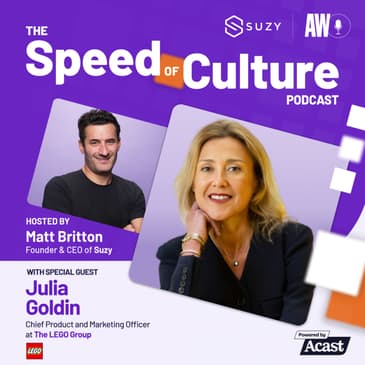
In this episode of The Speed of Culture, Matt Britton sits down with Julia Goldin, Chief Product & Marketing Officer at the LEGO Group. Julia shares how LEGO ignites creativity in both children and adults, discusses the brand’s exciting partnerships with global icons like Pharrell Williams, and highlights LEGO’s dedication to diversity and inclusion. Plus, she gives an inside scoop on the much-anticipated LEGO Movie set to release on October 11th!
Follow Suzy on Twitter: @AskSuzyBiz
Follow Julia Goldin on LinkedIn
Subscribe to The Speed of Culture on your favorite podcast platform.
And if you have a question or suggestions for the show, send us an email at suzy@suzy.com
Hosted on Acast. See acast.com/privacy for more information.
[00:00:01] [SPEAKER_01]: 65% of kids today in kindergarten will have jobs that don't exist today. So they need to be prepared more than anyone else for things that we can't anticipate. But what we do know, what we can anticipate is that they will need skills like imagination, creative problem solving, creative resilience, collaboration and communication. And these skills they get when they build with Lego bricks, when they build with each other, when they play with each other. And that's exactly what we want to prepare them for.
[00:00:33] [SPEAKER_00]: To thrive in a rapidly evolving landscape, brands must move at an ever increasing pace. I'm Matt Britton, founder and CEO of Suzy. Join me and key industry leaders as we dive deep into the shifting consumer trends within their industry, why it matters now and how you can keep up. Welcome to the Speed of Culture.
[00:00:54] [SPEAKER_00]: Up today, I'm very excited and thrilled to welcome Julia Goldin, the Chief Product and Marketing Officer of the Lego Group. Julia has been at the forefront of driving innovation and creativity at one of the world's most iconic brands.
[00:01:04] [SPEAKER_00]: Julia's were named by Campaign Magazine to the 2023 CMO 50 list and more recently was aimed to the 2024 Forbes Entrepreneurial 50 list. Today, we'll dive into how Lego continues to evolve and inspire across generations in today's fast-changing landscape. Julia, so great to see you.
[00:01:20] [SPEAKER_01]: Thank you for having me. Great to be here.
[00:01:22] [SPEAKER_00]: Absolutely. Where does this podcast find you today?
[00:01:25] [SPEAKER_01]: I'm actually in London at home.
[00:01:27] [SPEAKER_00]: You're in London.
[00:01:27] [SPEAKER_01]: Yeah, I spend a lot of time in Denmark. I spend a lot of time at our headquarters in Berlin because that's the heart of our innovation, but I landed just a day ago.
[00:01:38] [SPEAKER_00]: And what's it like at the Lego headquarters? What is the culture like there? And what do you think about the culture makes the company so different and enables it to execute the way that it has?
[00:01:46] [SPEAKER_01]: Well, I think that it's super committed and connected back to its roots in some ways. And then in other ways, it's extremely creative and open and agile and exciting.
[00:01:58] [SPEAKER_01]: So if I just talk to the values of the company, because we have a lot of different areas, but everywhere you go, the spirit of being connected by the same mission, everybody really evangelized and excited about the mission to reach as many kids as possible, to inspire and develop the builders of tomorrow.
[00:02:17] [SPEAKER_01]: Like anyone can tell you about it and they believe in it. We have very strong values that bring us together, fun, learning, quality, but also respect and caring for each other.
[00:02:30] [SPEAKER_01]: So there is that sort of spirit of fun that we also bring and play that we bring into the work world. And you see that everywhere.
[00:02:37] [SPEAKER_01]: You really feel that it's the home of the brick. It's the heart of the brick. Anywhere you go, you will find amazing and very inspiring Lego builds.
[00:02:45] [SPEAKER_01]: And that, of course, permeates the company as well. And then if I talk about where I work, because I'm in the building with all of the, where the innovation happens with all the designers, it's an incredible spirit of teamwork because we very much believe in one team mantra.
[00:03:02] [SPEAKER_01]: So when I get in, I kind of never see people sitting just at a desk. There's always buzz and noise and the sound of the bricks going.
[00:03:11] [SPEAKER_01]: And there's a lot of excitement and inspiration. And as you will get with creative people, a lot of dynamism.
[00:03:18] [SPEAKER_01]: And they're so excited to tell me about the things that they're working on and the things that they're thinking about for the future.
[00:03:23] [SPEAKER_01]: So I would say it's quite inspiring. It's fast. But a lot of people ask me, is it really as fun as you would imagine? And I would say, absolutely.
[00:03:31] [SPEAKER_01]: I mean, they have a mini golf course on top of one of the buildings. So they really encourage people to play in all kinds of different ways.
[00:03:39] [SPEAKER_01]: And I think that brings a lot of openness and creativity and risk taking into heart.
[00:03:44] [SPEAKER_00]: And play is obviously the center of the ethos of the Lego brand. I have small children and I can tell you, as you probably know, there's nothing as satisfying as seeing your kids sit down and play with Legos and imagine and build.
[00:03:59] [SPEAKER_00]: And in many ways, that activity, I think, is at odds with our current culture because parents are connected to their phones.
[00:04:05] [SPEAKER_00]: Teenagers are connected to their phones. There's screens and technology everywhere.
[00:04:09] [SPEAKER_00]: So do you find that kind of holding on to that core ethos of the brand is an uphill battle in this world?
[00:04:15] [SPEAKER_00]: And how do you kind of balance, I guess, the physical and digital spaces as you continue to evolve?
[00:04:20] [SPEAKER_01]: Well, I think if you look at our growth numbers, it wouldn't necessarily indicate that it's an uphill battle.
[00:04:26] [SPEAKER_01]: I think there's openness. And as a matter of fact, not just with kids, but also with teens and with adults.
[00:04:34] [SPEAKER_01]: What we're finding is actually it definitely pushes the bar of innovation because you have to really understand what people would love to build.
[00:04:42] [SPEAKER_01]: But the activity itself is extremely enduring and very engaging, especially if you're building something that you absolutely love.
[00:04:49] [SPEAKER_01]: So I think on the one hand, the physical building experience, I think, has gotten stronger and stronger and stronger.
[00:04:54] [SPEAKER_01]: But for sure, we are competing in a much broader world now in terms of all kinds of different things that you could be spending your time on.
[00:05:02] [SPEAKER_01]: So we need to work harder and set the bar higher in terms of the kind of innovation that we bring in.
[00:05:08] [SPEAKER_01]: So if I just give you a few examples, but I mean, you know, tapping into passion points has been one of the ways that we have a lot of that potential.
[00:05:15] [SPEAKER_01]: You probably see that with your kids, but maybe even with yourself.
[00:05:18] [SPEAKER_01]: But recent example is botanicals.
[00:05:21] [SPEAKER_01]: I mean, that's our best selling products are flower bouquets and the people of all ages love to build them.
[00:05:27] [SPEAKER_01]: Boys, girls, but also a lot of women who have not even ever grown up with a level break and they're really loving the experience.
[00:05:35] [SPEAKER_01]: So that just goes to show that there is so much excitement and interest if you give people the right thing.
[00:05:41] [SPEAKER_01]: Then in terms of digital, if I speak about children in particular, for sure, digital is a big part of their life and digital gaming is a big part of their life.
[00:05:50] [SPEAKER_01]: But we are actually really embracing it and we're embracing it in a few ways.
[00:05:54] [SPEAKER_01]: One way is that we are participating in a digital culture because we believe we can also bring very meaningful creative play to that environment in a way no one else can do.
[00:06:04] [SPEAKER_01]: So that's why we launched like a Fortnite last year and we continue to expand a lot of these types of experiences.
[00:06:09] [SPEAKER_01]: But even realizing the kids are digital natives, for example, in addition to paper instructions, we also have digital building instructions, which we know kids really enjoy because it's not just a replica of the physical instruction, but it has more immersive components where kids can get rewards.
[00:06:27] [SPEAKER_01]: They can get into the story.
[00:06:29] [SPEAKER_01]: They have a lot more options and we even have instructions that help them to build with others.
[00:06:34] [SPEAKER_01]: So it's actually a huge way of enhancing the physical play.
[00:06:40] [SPEAKER_01]: And then, of course, we bring digital straight into our play.
[00:06:43] [SPEAKER_01]: So if you actually look at products like Lego Super Mario, for example, or Technic with a remote control, that's where the digital play seamlessly comes together with physical play to actually create something that is really unique.
[00:06:57] [SPEAKER_01]: And given the popularity of these experiences, we are continuing on that path of innovation.
[00:07:03] [SPEAKER_01]: So there's more to come in the future.
[00:07:05] [SPEAKER_00]: Very cool.
[00:07:05] [SPEAKER_00]: So I've been speaking a lot lately about AI and what it means for the future of business and culture and society.
[00:07:12] [SPEAKER_00]: And a lot of times after I speak, I have people come up to me and say, I'm so freaked out.
[00:07:16] [SPEAKER_00]: What do I do about this?
[00:07:17] [SPEAKER_00]: What does it mean for my kids?
[00:07:18] [SPEAKER_00]: And what should they focus on in terms of their career path?
[00:07:21] [SPEAKER_00]: And one thing I usually tell them is go deep into an art or deep into a science, deep into an art, meaning doing something that the machines can't.
[00:07:28] [SPEAKER_00]: And I think the skill set you learn by playing with Legos falls into that category.
[00:07:33] [SPEAKER_00]: So it would seem to me that what Lego does in many ways more than ever now is are preparing kids for a world where you really need to differentiate through a sense of creativity.
[00:07:43] [SPEAKER_00]: Because if you're kind of just a jack of all trades, master of none, I think you're going to have a hard time in this new world.
[00:07:48] [SPEAKER_00]: I'm just curious to what your thoughts are in terms of what the future of careers are in this new world of AI and how creativity plays into that.
[00:07:57] [SPEAKER_01]: I think you're spot on.
[00:07:58] [SPEAKER_01]: I mean, I think we always have said that kids, when they play, they learn.
[00:08:02] [SPEAKER_01]: And when they play with level breaks, we know that that has a very meaningful way of impacting the kinds of things that they learn.
[00:08:09] [SPEAKER_01]: And we call them 21st century skills because these are not skills that you're going to learn through academics.
[00:08:14] [SPEAKER_01]: But these are skills that are really essential.
[00:08:16] [SPEAKER_01]: Like we know 65% of kids today in kindergarten will have jobs that don't exist today.
[00:08:21] [SPEAKER_01]: So they need to be prepared more than anyone else for things that we can't anticipate.
[00:08:26] [SPEAKER_01]: But what we do know, what we can anticipate is that they will need skills like imagination, creative problem solving, creative resilience, collaboration and communication.
[00:08:37] [SPEAKER_01]: And these skills they get when they build with Lego bricks, when they build with each other, when they play with each other.
[00:08:44] [SPEAKER_01]: And that's exactly what we want to prepare them for.
[00:08:47] [SPEAKER_01]: I would say a few things about AI.
[00:08:49] [SPEAKER_01]: Of course, generative AI is incredible innovation and the ability to ingest so much information and be able to analyze it and put something out.
[00:09:00] [SPEAKER_01]: But we have to remember, it's a trained mechanism.
[00:09:03] [SPEAKER_01]: It's a machine.
[00:09:04] [SPEAKER_01]: It will never replace human creativity.
[00:09:07] [SPEAKER_01]: And we also look at AI and then leverage AI in what we do and continuously see opportunities as we move toward the future.
[00:09:16] [SPEAKER_01]: But we know that even in our own creative processes and creative development, that human creativity can never be replaced.
[00:09:23] [SPEAKER_01]: So we feel we have a very strong role to play.
[00:09:26] [SPEAKER_01]: That's why our overall mission is to be a global force for learning to play, because we know that we can give kids agency that they cannot get just from a traditional educational method.
[00:09:38] [SPEAKER_00]: Yeah.
[00:09:38] [SPEAKER_00]: And I mean, traditional educational methods right now, the way I've seen it is kind of remember as much information you can by studying for a test and regurgitating it.
[00:09:47] [SPEAKER_00]: And I think that's exactly the opposite of the skill set that's going to be needed moving forward.
[00:09:51] [SPEAKER_00]: And I think it is about the building blocks of your brain in a creative problem solving sort of way that Lego kind of drives the practice of at early ages.
[00:10:00] [SPEAKER_01]: Yeah.
[00:10:00] [SPEAKER_01]: And one of the very famous people and educators and authority on education was Samuel Pepper.
[00:10:06] [SPEAKER_01]: He helped us to establish Lego education, actually, and some of the products like Mindstorms, which is one of the first interactive products with Lego bricks.
[00:10:14] [SPEAKER_01]: But he said, and this was like late 90s, if you look at the world today, and if you look at doctors, and if you can imagine a doctor being a doctor in early 20th century or 19th century, and you imagine being a doctor now in New York into a hospital, it's a completely different world with all the innovation that has happened.
[00:10:34] [SPEAKER_01]: But he said, if you go into school, it will be pretty similar.
[00:10:38] [SPEAKER_01]: So it's really about this kind of, and that's why he was a big proponent of changing the educational approach to actually take into account how the world needs to be prepared for the future.
[00:10:49] [SPEAKER_01]: And then the most important skills that you need to learn.
[00:10:53] [SPEAKER_01]: And I always say one of the most important, you know, that would be quote that I use is from another authority, sort of like futurologist, who said, illiterate of the future generations will not be people who cannot read or write.
[00:11:06] [SPEAKER_01]: There will be people who could not unlearn, relearn and learn again.
[00:11:10] [SPEAKER_01]: So that's the most important opportunity, because look at how much the world is changing.
[00:11:14] [SPEAKER_01]: And I think increasingly we need to be able to adapt to these changes.
[00:11:19] [SPEAKER_01]: And that's where creative resilience, that's where creative problem solving becomes crucial.
[00:11:24] [SPEAKER_00]: There's so much in there.
[00:11:25] [SPEAKER_00]: And I think when you talk about relearning again, a big part of that is also curiosity.
[00:11:28] [SPEAKER_00]: Because if you're curious, you want to relearn again.
[00:11:31] [SPEAKER_00]: And if you're curious, you want to know how maybe the Lego bricks fit in a way that isn't just a box, a nice little box.
[00:11:38] [SPEAKER_00]: And I think that's how you think literally outside the box and how you do new things.
[00:11:43] [SPEAKER_00]: And I think that's going to be so incumbent for being successful in this new era.
[00:11:48] [SPEAKER_00]: So you guys have done a lot of partnerships.
[00:11:50] [SPEAKER_00]: You mentioned Fortnite earlier, and I saw LinkedIn, you spoke about a recent partnership with Formula One.
[00:11:55] [SPEAKER_00]: When you think about partnerships and kind of tapping into brand equity of other brands, as well as they're tapping into yours to reach new audiences, what is kind of your decision making framework when evaluating partnerships?
[00:12:08] [SPEAKER_01]: So we always start with our audiences and what's important to them and what they're really passionate about.
[00:12:14] [SPEAKER_01]: So that's kind of why Fortnite or that's why Formula One, because we know that there is a huge passion point and it's increasingly inviting more and more families into the fold.
[00:12:26] [SPEAKER_01]: So we know that it's really relevant for kids and it's relevant for adults and it's a bit of a rite of passage.
[00:12:30] [SPEAKER_01]: But the other really big criteria is that we want to be able to bring incremental value to this experience.
[00:12:37] [SPEAKER_01]: We want to be able to pay something that will deepen the passion and give them more touch points in which they can engage into in their passion with.
[00:12:46] [SPEAKER_01]: So that's why F1, because we believe we can really bring completely new lens and this experience with immersive experiences, not just, of course, with products.
[00:12:56] [SPEAKER_01]: You can imagine how many of those we can have, but also with experiences that can happen at the races, that can happen around the races, that can happen for broader audiences.
[00:13:05] [SPEAKER_01]: So that's kind of the evaluation that goes into deciding who we want to partner with.
[00:13:11] [SPEAKER_01]: And then, of course, we spend a lot of time working through the relationship and how we would work with a partner, because that is also a very important element.
[00:13:19] [SPEAKER_01]: We really take partnerships very seriously.
[00:13:21] [SPEAKER_01]: It's actually one of our promises that we hold ourselves to, which is our partner promise about mutual value, patient and working as one team with our partners.
[00:13:30] [SPEAKER_01]: So it's really important that our values match.
[00:13:32] [SPEAKER_01]: It's really important that we can have a very strong collaborative relationship.
[00:13:36] [SPEAKER_01]: And we also have the same view and vision around things that are important to us, like diversity and inclusivity, sustainability, learning through play and things like that.
[00:13:47] [SPEAKER_01]: So that's kind of how these partnerships come together.
[00:13:49] [SPEAKER_01]: They are very deliberate.
[00:13:51] [SPEAKER_01]: There's not that many of them, but the ones that we have run deep.
[00:13:55] [SPEAKER_00]: We'll be right back with The Speed of Culture after a few words from our sponsors.
[00:13:58] [SPEAKER_00]: And, of course, partnerships take a lot of different forms.
[00:14:01] [SPEAKER_00]: Obviously, you have your traditional licensing partnerships where, obviously, the brand is integrated into the product.
[00:14:07] [SPEAKER_00]: And then you have what I guess I would call content partnerships.
[00:14:10] [SPEAKER_00]: And most notably, there's obviously a big partnership coming live in October with Pharrell and the movie Piece by Piece, which I'm personally incredibly excited for, which tells the story of record producer Pharrell Williams.
[00:14:21] [SPEAKER_00]: Just tell me about that partnership, how it came together and why that avenue of partnership makes sense in building the brand.
[00:14:28] [SPEAKER_01]: Yeah. So Pharrell is obviously a super inspirational figure because he's not just an artist and he has actually demonstrated ability to embrace so many different genres.
[00:14:41] [SPEAKER_01]: He is a changemaker.
[00:14:42] [SPEAKER_01]: He is a tastemaker.
[00:14:44] [SPEAKER_01]: He is a designer.
[00:14:45] [SPEAKER_01]: He is an artist.
[00:14:46] [SPEAKER_01]: He is an entrepreneur.
[00:14:47] [SPEAKER_01]: There is just no stop.
[00:14:49] [SPEAKER_01]: And I'm sure that you'll see more facets of Pharrell moving forward.
[00:14:51] [SPEAKER_01]: But he's an incredibly creative person.
[00:14:54] [SPEAKER_01]: And so he actually came up with the idea of telling his story via Lego bricks.
[00:15:01] [SPEAKER_01]: And so he came to us with the idea of telling the story via Lego animation and bringing that world to life.
[00:15:07] [SPEAKER_01]: And we really embraced it because not only because it's interesting and it's exciting and it's great, but it's also very much, again, what I spoke to because of the values.
[00:15:17] [SPEAKER_01]: Pharrell has his story, his values, what's important to him is all about unlocking the potential in children, unlocking the potential in his followership, but in future generations.
[00:15:29] [SPEAKER_01]: Sharing his personal journey of believing in his dreams, breaking out of the reality that he grew up in and actually going for the impossible dream and achieving it, losing focus and then getting himself back up and what it actually takes and standing up for things that he really believes in.
[00:15:48] [SPEAKER_01]: And this matches so well with the kinds of values that we have and that we want to represent for our community.
[00:15:54] [SPEAKER_01]: And actually, as I said before, we actually don't parcel our partnerships into content, product, etc.
[00:16:01] [SPEAKER_01]: But we want to pay remorse of experiences.
[00:16:03] [SPEAKER_01]: So with Pharrell, not only is the movie coming out, but we also designed the product with him.
[00:16:08] [SPEAKER_01]: So again, he worked with us in a very collaborative process with our designers and the product has not been announced and it's now available to purchase.
[00:16:16] [SPEAKER_01]: And it's amazing because it has a rocket that goes to the moon to represent this kind of idea that anybody can realize their potential.
[00:16:23] [SPEAKER_01]: So the product has an abacus that has 51 minifig heads that represent seven different skin tones.
[00:16:30] [SPEAKER_01]: So it just gives us tremendous kind of view of diversity and inclusivity.
[00:16:35] [SPEAKER_01]: And that's, of course, one of the things that is super important to the Lego group and to Pharrell.
[00:16:39] [SPEAKER_01]: So it's a very unique product.
[00:16:41] [SPEAKER_01]: And it's, again, a representation of ideas.
[00:16:44] [SPEAKER_01]: And it's a beautiful representation also of the Lego brand values and ideals.
[00:16:49] [SPEAKER_01]: So this is a good example of where things are really come together and become more than just even the original idea, but something that is holistic and bigger.
[00:17:01] [SPEAKER_01]: Pharrell and who he is in a very unique way to so many of his followers that they're able to build a product that he designed that is one of a kind.
[00:17:10] [SPEAKER_00]: Yeah, and that product is called Over the Moon.
[00:17:12] [SPEAKER_00]: So make sure you search it, those in the audience, and check it out.
[00:17:15] [SPEAKER_00]: I'm looking at it now.
[00:17:16] [SPEAKER_00]: It looks amazing.
[00:17:16] [SPEAKER_00]: So I can't wait to see that movie.
[00:17:18] [SPEAKER_00]: And it's such a cool partnership.
[00:17:20] [SPEAKER_00]: So Lego has also seen real success by expanding to the adult market.
[00:17:24] [SPEAKER_00]: And I think many people don't realize how popular Lego is with adults and a lot of the same values and, I guess, lessons and building frameworks it gives the kids.
[00:17:33] [SPEAKER_00]: It gives to adults and people of all ages.
[00:17:35] [SPEAKER_00]: Tell me about Lego's efforts in the adult market and why you've seen such success there and maybe what your future plans are in that realm.
[00:17:41] [SPEAKER_01]: Yeah, we've kind of, we've always been popular with adults, but we were never super deliberate about it.
[00:17:47] [SPEAKER_01]: And about six years ago, we decided that the world was under a lot of pressure, was actually before COVID.
[00:17:53] [SPEAKER_01]: But we were feeling that the world was under a lot of pressure and we could see the insights around the fact that we were actually giving adults a very unique experience that they crave.
[00:18:02] [SPEAKER_01]: And so we started by opening the aperture of who we consider to be a consumer target rather than thinking about it as kids who grew up with Lego bricks and just continue to build straight into their basements to create their big Lego workshops.
[00:18:17] [SPEAKER_01]: We started to look at everybody who can actually be interested in taking a moment for themselves, engaging in their passion, engaging in their hobby and building something that they really love.
[00:18:26] [SPEAKER_01]: And that opened up a massive opportunity because we saw that there was a lot of interest, but we didn't have all the right products because we weren't tapping into that many different passion points.
[00:18:36] [SPEAKER_01]: And actually our products were not visible or discoverable for adults.
[00:18:41] [SPEAKER_01]: So that was so part of it.
[00:18:42] [SPEAKER_01]: And so we started to look at the key passion points in developing products that fit into different passion points.
[00:18:48] [SPEAKER_01]: Some of them are, we were already doing like entertainment IPs, for example, like Star Wars or Marvel, which has huge fellowship with adults, vehicles, of course, like big Technicars.
[00:19:00] [SPEAKER_01]: But there was a few new ones like art, flowers and botanicals and really kind of just iconic nostalgia sets.
[00:19:09] [SPEAKER_01]: And that's kind of where we started.
[00:19:12] [SPEAKER_01]: The portfolio, because we worked two years out, actually happened to launch in 2020.
[00:19:16] [SPEAKER_01]: And we all know what happened in 2020.
[00:19:19] [SPEAKER_01]: So I think that, of course, propelled more adults to start building like that.
[00:19:23] [SPEAKER_01]: But what has been amazing is that trend has just stayed.
[00:19:27] [SPEAKER_01]: Despite the fact that COVID is behind us, we see continuously more and more adults coming in.
[00:19:32] [SPEAKER_01]: And they've had some really big surprises like Lego flowers and women.
[00:19:37] [SPEAKER_01]: That's our number one recruitment target or target audience with adults.
[00:19:40] [SPEAKER_01]: They're recruiting a lot of women.
[00:19:43] [SPEAKER_01]: And some of them have never built with Lego bricks, but they just love to take that moment to build something that they're passionate about, to be able to express their creativity because they can, of course, build the bouquet that they are buying, but they can also create their own bouquets.
[00:19:55] [SPEAKER_01]: And you can just go and tick back on YouTube and you see the amount of activity happening in the space.
[00:20:00] [SPEAKER_01]: So why is this so relevant?
[00:20:03] [SPEAKER_01]: I think because adults need exactly that same experiences that we just talked about.
[00:20:09] [SPEAKER_01]: They need to go through some of this, even probably more than kids.
[00:20:13] [SPEAKER_01]: They need to be able to express their creativity, take time for themselves, enjoy something.
[00:20:18] [SPEAKER_00]: Disconnect, right?
[00:20:19] [SPEAKER_00]: Also disconnect from the constant buzzing of the phone.
[00:20:21] [SPEAKER_01]: Yeah, but also go through something that engages them to be creative, to have creative resilience, to make mistakes, to troubleshoot, to find their way out.
[00:20:33] [SPEAKER_01]: And then to be super proud of something that they have created that they can display.
[00:20:38] [SPEAKER_01]: And I think you can't replicate it with anything.
[00:20:40] [SPEAKER_01]: There's no other experience that's like that.
[00:20:44] [SPEAKER_01]: So if you build a Concorde or if you went to Paris for the Olympics and you want to have a memento of Notre Dame, or if you have built Van Gogh Starry Night, but in the 3D version that doesn't exist in any other.
[00:20:57] [SPEAKER_01]: Then for people, it's like a huge amount of pride also in doing that.
[00:21:01] [SPEAKER_01]: So that's why I think we are seeing this.
[00:21:03] [SPEAKER_01]: I think adults around the world need this.
[00:21:06] [SPEAKER_00]: Yeah.
[00:21:06] [SPEAKER_00]: And speaking of being around the world, Lego sold in over 130 countries around the world.
[00:21:10] [SPEAKER_00]: And obviously, there's probably some commonalities that are innately human, regardless of where in the world you're marketing a product.
[00:21:17] [SPEAKER_00]: But I would imagine there's also cultural nuances from market to market.
[00:21:21] [SPEAKER_00]: So I guess, how do you look at being a global marketer?
[00:21:23] [SPEAKER_00]: And what have you learned during your time at Lego that's made you effective at making sure that you're speaking to people in ways that are culturally relevant?
[00:21:31] [SPEAKER_01]: I think that's a really key point.
[00:21:33] [SPEAKER_01]: So my role spans both product and marketing and brand.
[00:21:36] [SPEAKER_01]: So I look at everything.
[00:21:38] [SPEAKER_01]: And we have video, our portfolio is global.
[00:21:41] [SPEAKER_01]: So I think the first question actually starts with a portfolio because we have almost 800 products, but you need to make the choices that actually are going to be able to be relevant and resonate across the world.
[00:21:53] [SPEAKER_01]: So we actually take a lot of time to understand what kids are into, what people are into.
[00:21:58] [SPEAKER_01]: And it's very granular amongst adults, amongst kids, different genders, different age groups, different passion points.
[00:22:04] [SPEAKER_01]: And we try to find sort of the right portfolio that spans as much as possible and is relevant as much as possible.
[00:22:11] [SPEAKER_01]: But in our portfolio, you could also see that the inspiration from different markets comes in, different cultures comes in.
[00:22:18] [SPEAKER_01]: For example, Chinese New Year.
[00:22:19] [SPEAKER_01]: We always do something for Chinese New Year, but it happens to be best-selling products, not just in China, but around the world.
[00:22:25] [SPEAKER_01]: Flowers, they're inspired by different traditions like Valentine's Day, Red Roses bouquet.
[00:22:31] [SPEAKER_01]: But similarly, we have orchids, which have obviously been inspired by Asia in Asian cultures.
[00:22:36] [SPEAKER_01]: So you could see representation of different things that are relevant in the portfolio.
[00:22:41] [SPEAKER_01]: We tend to look at entertainment IPs that resonate across the board.
[00:22:45] [SPEAKER_01]: Some influences come from different markets like anime, for example.
[00:22:50] [SPEAKER_01]: It came most from East to West, whereas some of the big entertainment IPs like Disney comes the other way.
[00:22:56] [SPEAKER_01]: So that's one big piece.
[00:22:58] [SPEAKER_01]: But the other really, really big piece is about having a brand with a message that resonates around the world.
[00:23:06] [SPEAKER_01]: And our campaigns around the brand, like We Build the World campaign, for example, it talks about creative resilience.
[00:23:12] [SPEAKER_01]: And it talks about creativity and the importance of unlocking imagination and giving children and the world the opportunity to play.
[00:23:19] [SPEAKER_01]: We know that that message resonates around the world.
[00:23:21] [SPEAKER_01]: So we also want to ensure that we stay with the insights and the messages that really resonate.
[00:23:27] [SPEAKER_01]: But then how we bring it to life is very important.
[00:23:31] [SPEAKER_01]: And that's where we have a lot of opportunity to also be more specific to different cultures and to be more relevant and resonant and celebrate with them the things that are important to them.
[00:23:42] [SPEAKER_01]: So, for example, we will do some incremental activations with the Black communities in the U.S., specifically around the Feral Zone, but also some of the other things that we do.
[00:23:52] [SPEAKER_01]: And similarly, we will do extra activations to celebrate some of the really key moments in China, like Chimna's Play Day or Chinese Lunar New Year and bring kind of a local celebration and local relevance.
[00:24:06] [SPEAKER_01]: And that includes holidays.
[00:24:08] [SPEAKER_01]: That includes key moments.
[00:24:10] [SPEAKER_01]: So there's also a lot of work around balancing the global and the local.
[00:24:14] [SPEAKER_01]: And I think that's really important because you need to be relevant to the market in which you operate.
[00:24:18] [SPEAKER_01]: So we also support a lot of that.
[00:24:20] [SPEAKER_01]: Like this year, for example, we really supported Olympics.
[00:24:23] [SPEAKER_01]: It was on the global scale, but there's also some very specific activations that happened in Paris to really bring that celebration of the French culture to life.
[00:24:32] [SPEAKER_00]: It's a lot to manage, for sure, to make sure you're executing at the right level.
[00:24:36] [SPEAKER_01]: Exactly.
[00:24:37] [SPEAKER_00]: So shifting gears as we wrap up here and just talking about you and the way that you approach your work, obviously driving marketing and product for an iconic brand like Lego, you need to make sure that it doesn't become a legacy brand, that you're making sure that you're contemporizing it and looking ahead.
[00:24:53] [SPEAKER_00]: And it's clear through the examples we talked about today that you're doing that.
[00:24:56] [SPEAKER_00]: What do you do personally to make sure that you have your finger on the pulse of where culture is headed to make sure that you're always have your eye towards what's next?
[00:25:05] [SPEAKER_00]: Where do you spend your time researching and connecting with to put you in a position to do that?
[00:25:09] [SPEAKER_01]: I think experiences are very important.
[00:25:11] [SPEAKER_01]: So I am very curious and I love culture.
[00:25:16] [SPEAKER_01]: And so I tend to, I'm also very lucky because I live in London.
[00:25:21] [SPEAKER_01]: London is very multicultural, but I tend to throw myself into learning and experiencing new things, not just the things that I love, which I do a lot.
[00:25:29] [SPEAKER_01]: And of course, that's very inspirational.
[00:25:30] [SPEAKER_01]: I go to the theater.
[00:25:31] [SPEAKER_01]: I have a lot of different passions, but it's also reading.
[00:25:35] [SPEAKER_01]: It's also kind of understanding what's hard.
[00:25:37] [SPEAKER_01]: I'm very lucky that in my family, I have boys.
[00:25:41] [SPEAKER_01]: And so they push me a lot into sports.
[00:25:44] [SPEAKER_01]: That's how I also discovered Formula One and fell in love with it.
[00:25:48] [SPEAKER_01]: So I have a lot of different layers to what I do, but I don't spend a lot of time just sitting and reading books about marketing.
[00:25:56] [SPEAKER_01]: I spend the time understanding what people are into, looking at what's hard, looking at it and understanding it,
[00:26:04] [SPEAKER_01]: like going to shows, watching the programs that kids watch, seeing what they're playing, playing the games myself.
[00:26:12] [SPEAKER_01]: I think that's what's needed.
[00:26:14] [SPEAKER_01]: And just anticipating and sensing what's happening out there and being connected, both in the popular culture, but also connected from the culture in general.
[00:26:23] [SPEAKER_01]: And then traveling and just being out there, going to China and immersing myself to understand how do Chinese people live?
[00:26:30] [SPEAKER_01]: So what are they into?
[00:26:31] [SPEAKER_01]: What are kids into?
[00:26:32] [SPEAKER_01]: What are parents into?
[00:26:33] [SPEAKER_01]: What are they thinking about?
[00:26:35] [SPEAKER_01]: What are they talking about?
[00:26:36] [SPEAKER_01]: So I think it's been always very important to me.
[00:26:38] [SPEAKER_01]: I always consider myself a very international person because I lived in different places and I'm open to different cultures.
[00:26:44] [SPEAKER_01]: And I think that helps a lot.
[00:26:45] [SPEAKER_00]: Yeah, really living it, really living the culture and understanding it seems like it is a huge advantage for you.
[00:26:51] [SPEAKER_00]: And then how you impart, yeah, and being curious.
[00:26:54] [SPEAKER_00]: So in terms of younger people that are coming to the marketing world that one day perhaps end up in the CMO seat of an iconic brand like Lego, what advice would you have for them?
[00:27:04] [SPEAKER_01]: I would say the one thing that I already mentioned about learning, unlearning, relearning, I think that is super important to stay relevant.
[00:27:11] [SPEAKER_01]: Because whatever the world is that you think of, you know, today, whatever the basis that consider that to be a base and just anticipate that everything about marketing will change moving forward like five years from now, 10 years from now.
[00:27:25] [SPEAKER_01]: And you need to kind of stay with the game.
[00:27:27] [SPEAKER_01]: So if you actually think about, you know, when I started, we did media and Excel spreadsheets.
[00:27:32] [SPEAKER_01]: Look at what we're doing now.
[00:27:34] [SPEAKER_01]: So you can't rely on just continuously hiring people who are coming from new generations.
[00:27:40] [SPEAKER_01]: You have to know it yourself.
[00:27:41] [SPEAKER_01]: You have to learn it yourself.
[00:27:42] [SPEAKER_01]: And you have to forget what you learned before because things will change.
[00:27:46] [SPEAKER_01]: So I would say that's one.
[00:27:48] [SPEAKER_01]: And the second thing is take risks and go and live and work in different places.
[00:27:53] [SPEAKER_01]: I don't think I can replace the experiences that I've had with anything else, in my view, because I worked almost everywhere in the world.
[00:28:01] [SPEAKER_01]: I lived in Japan.
[00:28:02] [SPEAKER_01]: I lived in Europe.
[00:28:03] [SPEAKER_01]: I lived in U.S.
[00:28:05] [SPEAKER_01]: I lived in New York, which is kind of a world of its own.
[00:28:08] [SPEAKER_01]: And I think that that makes a huge difference, being able to experience different cultures, but also live there and work there.
[00:28:15] [SPEAKER_01]: I think that just helps with also building your leadership.
[00:28:19] [SPEAKER_01]: And I think at the end of the day, that's essential.
[00:28:21] [SPEAKER_00]: We hear that so much.
[00:28:23] [SPEAKER_00]: Every guest we've had that has had international experience say it's a huge part of developing the professional that they are today.
[00:28:29] [SPEAKER_00]: So it's great to hear that you concur with that.
[00:28:31] [SPEAKER_00]: So wrapping up here, Julia, is there a quote or mantra that you like to guide your professional journey by that comes to mind?
[00:28:38] [SPEAKER_01]: So in my journey, where I have been always very lucky with, I think what's helped me to be where I am today is the fact that I really am passionate about what I do.
[00:28:49] [SPEAKER_01]: I think being passionate about what you do is super important.
[00:28:52] [SPEAKER_01]: And at one point, Einstein, when he moved to the U.S. and his family was still in Germany and he did amazing things, of course.
[00:29:00] [SPEAKER_01]: But he wrote to his son on his career choice and he wrote to him, son, whatever you choose, you need to choose something that you're really passionate about.
[00:29:09] [SPEAKER_01]: Because if you're passionate about it, you will do it well.
[00:29:12] [SPEAKER_01]: So if you're passionate about playing the piano, then be a pianist.
[00:29:16] [SPEAKER_01]: If you're passionate about science, then be a scientist.
[00:29:18] [SPEAKER_01]: If you're passionate about being a carpenter, then do that.
[00:29:20] [SPEAKER_01]: I think that's super important.
[00:29:22] [SPEAKER_01]: So my mantra first is that I need to be passionate and excited about what I do because that's what drives me and that's what makes every day super special.
[00:29:31] [SPEAKER_01]: And I also feel that it becomes part of my life and that I don't really separate professionally, personal life.
[00:29:38] [SPEAKER_01]: And the second point is that I grew up in the Soviet Union.
[00:29:42] [SPEAKER_01]: I was very lucky to leave with my parents when I was a teenager.
[00:29:46] [SPEAKER_01]: But I grew up in a world of a lot of constraints where there's a lot of things I wanted to do that I never thought I'd be able to do, like travel or experience certain things.
[00:29:55] [SPEAKER_01]: And the mantra that I have is that you have to do something in every day that makes that day memorable.
[00:30:01] [SPEAKER_01]: Don't let your days just fly by and become mundane.
[00:30:04] [SPEAKER_01]: So I always focus on that, that I always feel my day at least with something that I will remember, whether it's a book that I read or it's something that I watch, something that I learn, some show that I want to.
[00:30:17] [SPEAKER_01]: So those are the two things probably that are.
[00:30:19] [SPEAKER_00]: I love that.
[00:30:20] [SPEAKER_00]: Well, for today, Julia, this podcast interview with you is memorable to me.
[00:30:24] [SPEAKER_00]: So thank you so much for taking time out of your busy schedule.
[00:30:27] [SPEAKER_00]: The speaker will say it's been fascinating.
[00:30:29] [SPEAKER_00]: On behalf of Suzy and Adweek team, thanks again to the great Julia Golden, Chief Product and Marketing Officer at the Lego Group, for joining us today.
[00:30:35] [SPEAKER_00]: Be sure to subscribe, rate, and view the Speed of Culture podcast on your favorite podcast platform.
[00:30:39] [SPEAKER_00]: Until next time, see you soon, everyone.
[00:30:40] [SPEAKER_00]: Take care.
[00:30:45] [SPEAKER_00]: The Speed of Culture is brought to you by Suzy as part of the Adweek Podcast Network and A-Guest Creator Network.
[00:30:51] [SPEAKER_00]: You can listen and subscribe to all Adweek's podcasts by visiting adweek.com slash podcasts.
[00:30:57] [SPEAKER_00]: To find out more about Suzy, head to suzy.com.
[00:31:00] [SPEAKER_00]: And make sure to search for the Speed of Culture in Apple Podcasts, Spotify, and Google Podcasts, or anywhere else podcasts are found.
[00:31:07] [SPEAKER_00]: Click follow so you don't miss out on any future episodes.
[00:31:10] [SPEAKER_00]: On behalf of the team here at Suzy, thanks for listening.