
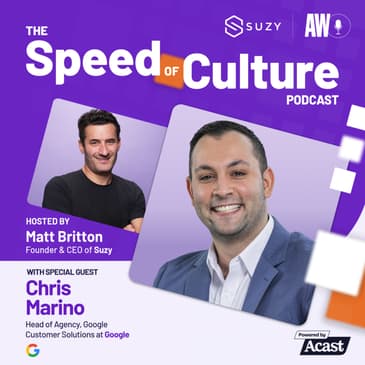
In this episode of The Speed of Culture podcast, Matt Britton speaks with Chris Marino, Head of Agency, Google Customer Solutions at Google. Chris shares his journey from American Express to Google, diving into the power of mentorship, the impact of AI on marketing, and the importance of personalized consumer engagement.
Follow Suzy on Twitter: @AskSuzyBiz
Follow Chris Marino on LinkedIn
Subscribe to The Speed of Culture on your favorite podcast platform.
And if you have a question or suggestions for the show, send us an email at suzy@suzy.com
Hosted on Acast. See acast.com/privacy for more information.
[00:00:01] Right now is the greatest time ever to be a marketer because it feels like we are at the next evolution of the industry as we know it today. When I think about AI, I think a lot of it is going to come in the space of how do we enhance productivity, how do we automate processes, and how do we actually deliver on modern customer experience. And I think that's where personalization starts to come in.
[00:00:27] To thrive in a rapidly evolving landscape, brands must move at an ever increasing pace. I'm Matt Britton, founder and CEO of Suzy. Join me and key industry leaders as we dive deep into the shifting consumer trends within their industry, why it matters now, and how you can keep up. Welcome to the Speed of Culture.
[00:00:49] Up today, we're thrilled to introduce a true star in the field of marketing, Chris Marino, the head of agency and customer solutions at Google. Chris has a decade of experience leading B2C and B2C.
[00:00:59] digital marketing transformations at Fortune 100 companies. Chris, so great to see you today.
[00:01:03] Matt, thank you so much for having me.
[00:01:05] Absolutely.
[00:01:05] One of my favorite podcasts, so such a pleasure to be here with you.
[00:01:08] Awesome. It's great to have you on a busy fall morning in New York City.
[00:01:11] And we were just kind of chit-chatting before we started about how you kind of dove into the corporate world, more specifically your first role at American Express.
[00:01:19] Why don't you tell the audience about how you landed a gig there?
[00:01:21] Yeah. And I think this will very much allude to my mantra, right?
[00:01:24] Okay.
[00:01:25] You miss 100% of the shots. You don't take.
[00:01:27] But I started and I went to school at Syracuse University, and I was a double major in management and marketing.
[00:01:34] Okay.
[00:01:34] And I had lived in New York City and worked in New York City, but I never had any corporate experience.
[00:01:40] I mean, who would have coming out of college, right?
[00:01:42] Totally. Hard to find that experience.
[00:01:43] So I was looking for an internship.
[00:01:46] And through the process, I actually remembered a conversation that I had at my high school where I had a senior executive named Steve Squarey.
[00:01:54] At the time, he was the CIO of American Express.
[00:01:57] Come and speak.
[00:01:58] And he talked all about how he grew up in my neighborhood, went to the same high school, had a lot of shared values.
[00:02:04] And I said, I've got to find a way to get in touch with Steve.
[00:02:07] And so I did my due diligence.
[00:02:09] And of course, I found this high school alumni networking website.
[00:02:13] And I sent Steve an email to his AOL email address.
[00:02:17] Now, is this when you were still in college or after you graduated?
[00:02:19] When I was still in college.
[00:02:20] Okay, gotcha.
[00:02:20] So I was a rising sophomore.
[00:02:22] Gotcha.
[00:02:23] So when you said earlier, you were looking for corporate experience, I thought you were saying post-graduation, but you're saying you were looking for an internship.
[00:02:29] Yeah, my first internship.
[00:02:29] You wanted to get your feet wet.
[00:02:30] Something to give me some experience.
[00:02:32] Yep.
[00:02:32] And I emailed Steve.
[00:02:34] And I didn't think he would get back to me.
[00:02:36] And two weeks later, sure enough, he sent me a note.
[00:02:39] And my first time in a corporate building was actually on the top floor of American Express.
[00:02:46] So let me pause you for one second because the action you took is a difference.
[00:02:49] You talk about you miss 100% of the shots you don't take.
[00:02:52] And many people don't take the shot that you just talked about emailing Steve.
[00:02:56] What do you think gets in the way for a lot of people that caused them not to send an email like that?
[00:03:01] Because that could change the course of their career or their life if they send it or if they don't.
[00:03:04] I think it's fear of not being responded to.
[00:03:08] Right.
[00:03:08] And I think if you are comfortable with the fact that, hey, that wasn't the only email I sent.
[00:03:13] In fact, I probably sent 20 of those emails to executives that were across my network and I got a few responses.
[00:03:20] But one response to your point has the potential to change your entire career.
[00:03:24] Yeah, and there's a saying that like every no gets you closer to yes.
[00:03:27] I think what a lot of people do in my opinion is they send out an email like that and the person doesn't respond and they take it personally.
[00:03:34] I'm not good enough.
[00:03:35] I'm not important enough when the reality is they have their own life going on.
[00:03:39] They have their family.
[00:03:39] They have their own job.
[00:03:40] They're traveling.
[00:03:41] Maybe there's health issues.
[00:03:42] Who knows?
[00:03:43] And I think the default being, oh, it must be me is another reason why people.
[00:03:48] So fear, it's also insecurity, I guess.
[00:03:49] Totally.
[00:03:50] That's a great point.
[00:03:50] I couldn't agree more.
[00:03:51] And if you can overcome that, because I think that's not just a lesson early in your career, but it's a consistent lesson throughout the course of your entire career.
[00:03:59] Even now, there are sometimes mentors that I reach out to that may or not respond.
[00:04:04] But when they do, it's a game changer.
[00:04:06] I mean, it wasn't easy getting Chris Marino on our podcast, right?
[00:04:09] I mean, it takes time.
[00:04:11] So going back to your story.
[00:04:12] So Steve finally responded to you and what happened?
[00:04:15] So Steve responded to me and he had me in American Express for the first time.
[00:04:19] And I remember sitting in the executive library, which was, and I just bought a suit with my mom from Macy's, probably one of my first suits.
[00:04:26] Right.
[00:04:27] And I'm sitting in this executive library and my legs are shaking because I'm so nervous.
[00:04:31] I'm kind of like, who did I just reach out to?
[00:04:34] Right.
[00:04:34] I didn't realize at that point in my life.
[00:04:37] And we had an incredible conversation.
[00:04:39] It was all about sort of personal values, career aspirations and the brand and a brand I admired and still admire to this day.
[00:04:48] And that created an opportunity for me to go through an interview process and become an intern.
[00:04:53] And I ended up spending the next 10 years of my career at American Express.
[00:04:57] So that conversation led to a game changing moment in my career and a mentorship relationship that I fostered and still keep in touch with him all of these years later.
[00:05:07] And when you wrote that email to him, was it just, hey, we went to high school together?
[00:05:12] I mean, do you remember kind of how you crafted it in a way that would be a hook?
[00:05:16] Totally.
[00:05:16] So his speech was all about climbing the corporate ladder and how you went about it.
[00:05:21] That was his shtick, basically.
[00:05:23] That was his shtick.
[00:05:23] Right, right, right.
[00:05:24] And it was how he got to where he got to.
[00:05:27] And I crafted a note and it was all about how his lessons in that speech really resonated with me.
[00:05:34] And these were the three things that I took from it.
[00:05:38] And this is why I wanted to connect with him coming from the same shared background.
[00:05:42] Yeah.
[00:05:42] Right.
[00:05:43] My parents never went to college.
[00:05:44] They never worked in corporate America.
[00:05:46] And so having someone who can help provide guidance at that moment was really important for me.
[00:05:52] And it stuck out.
[00:05:53] It resonated.
[00:05:54] It wasn't a generic note.
[00:05:55] And that would be my guidance to people, right, is really be thoughtful with those notes.
[00:05:58] Whether you get a response or not.
[00:06:00] It forces you to do research.
[00:06:02] It forces you to find ways to connect.
[00:06:05] And that's what it's really all about.
[00:06:06] What's amazing you say that because I get so many inbound notes of vendors or people that want a job.
[00:06:12] And 99 point, 999 out of 1000 are generic, find, replace, Matt, or Joe, or Jen, or Steven.
[00:06:19] And you could tell that they really don't want to work with Susie or work for Susie.
[00:06:24] They just want to get the email out and hope that someone's going to do the work for them.
[00:06:28] And ultimately, I think people need to take the time and figure out what do I really want.
[00:06:33] And if I really want this, I'm going to put in the work and I'm going to make it happen.
[00:06:37] And so many people are just content of saying copy, paste, send.
[00:06:40] And if it doesn't happen, oh, there must be some reason why.
[00:06:44] A hundred percent.
[00:06:44] You got to make it happen.
[00:06:45] Yep.
[00:06:46] Right.
[00:06:46] And research is so important.
[00:06:48] And finding ways to connect with people is the core of that.
[00:06:52] Right.
[00:06:52] And if you can connect research with connection, that's how you make these really lifelong relationships.
[00:06:56] And you start to think about how can you always be adding value to someone else?
[00:07:01] And I think that's what great mentorship is all about.
[00:07:03] It's got to go both ways.
[00:07:05] And I pay it forward all of the time.
[00:07:07] And that's a big component.
[00:07:09] A huge component.
[00:07:10] I agree a hundred percent.
[00:07:11] So you got hired at Amex out of college entry level job, and you ended up being there for seven years in 2013 to 2020.
[00:07:18] Talk to us about your experience at Amex and what are some of the key takeaways you have from that time?
[00:07:22] Yeah.
[00:07:23] I mean, working at American Express was one of the best experiences of my career.
[00:07:28] I always say a few things about Amex even years later.
[00:07:31] One, American Express is the most customer-centric company that I've ever worked at.
[00:07:36] And so I'll be a card member for the rest of my life, unquestionably.
[00:07:40] The second is American Express is the best marketing company that I've ever worked at.
[00:07:45] And so it was a great place to really refine your skills.
[00:07:48] And so when I think about my experience at Amex, a big focus for the company is how do we help develop a general management skill set and help someone diversify their experience within a discipline?
[00:08:00] And so I started in marketing, and I had the opportunity to do all different types of roles in marketing.
[00:08:06] I did traditional marketing.
[00:08:07] I did marketing analytics.
[00:08:09] I was a chief of staff to the CMO of our B2B division.
[00:08:13] I ran social media strategy globally back in 2017.
[00:08:16] We were trying to figure out what does social first look like for the industry and how does that translate at a Fortune 100 company?
[00:08:24] And then I went to run performance marketing in the U.S.
[00:08:26] And so I look at the company and the opportunity that they gave me to round myself out as a marketer, and that is just tremendous.
[00:08:34] Not every company gives you that type of opportunity.
[00:08:37] And so I'm forever grateful for my time there because it taught me what great marketing looks like.
[00:08:44] And it's informed how I've thought about marketing for the rest of my career.
[00:08:47] Yeah, and it seems like you took that same approach that you took even before you got the original internship at Amex, which was create connections with people all around the company.
[00:08:56] And as you're talking, my mind's going into place that when you joined Amex, if it was a remote, you probably wouldn't have had the same opportunities.
[00:09:04] You really had because you were rubbing elbows with people all day long at the Amex Tower and that opened up relationships.
[00:09:09] So, I mean, how important was it that you were in person during that time?
[00:09:13] And what advice do you have for people that want to take the same approach in a remote environment?
[00:09:16] I would have never gotten to where I was at American Express if it was remote.
[00:09:21] Right.
[00:09:21] Right.
[00:09:22] American Express was always really great about prioritizing work in life.
[00:09:27] And that meant that on Fridays, more often than not, we worked from home.
[00:09:30] But Monday through Thursday, I was in the office and creating connections with people in authentic ways.
[00:09:38] That's what it's all about.
[00:09:39] I remember one of my first jobs, I was exposed to my VP.
[00:09:44] And I didn't work super closely with him, but I sat outside of his office.
[00:09:48] Yeah.
[00:09:48] And I started to understand what was important to him.
[00:09:50] And he was having a hard time with employee engagement.
[00:09:53] And I said, hey, Cliff, you know what?
[00:09:54] Why don't I help you build an employee engagement plan?
[00:09:57] And I started doing his town halls and I started doing his newsletters and I started creating team events.
[00:10:02] And these were the types of relationships that you foster in person.
[00:10:06] And he was personally invested in me at that point.
[00:10:09] And so I think if people are not going into the office, it's going to be very hard to not only build the skills, but it's going to be hard to build the relationships that you need to succeed.
[00:10:19] Because at 22, being able to be comfortable knocking on the door of my VP and finding a way to add value in his day to day life was critical.
[00:10:28] And when I was there in the office on a Friday, when most people were working from home, what did that mean?
[00:10:33] That meant I was having lunch.
[00:10:34] Yeah.
[00:10:34] Cliff, right?
[00:10:35] That's right.
[00:10:35] And I got to connect organically.
[00:10:37] And so people need to be thinking about this.
[00:10:39] And I tell my younger brother this all the time.
[00:10:41] I would highly recommend if people are there twice a week, you should be in four days a week, right?
[00:10:46] Stand out.
[00:10:47] Find ways to stand out.
[00:10:48] And you also spoke about all those additional tasks that you did.
[00:10:51] I would imagine many of them were not part of your job description.
[00:10:53] And one thing I've seen throughout my career is people who just work very linearly within the context of their job description kind of get what they ask for, which is you're just in the job.
[00:11:03] And they wonder why didn't get promoted because you're doing what you're being paid to do.
[00:11:07] You basically look for any area you could take initiative and help the business.
[00:11:12] And that's probably what helped you have the upward mobility that you had.
[00:11:15] So like, what advice would you have for people at companies to seek out, I guess, those additional things to be able to drive value outside your core job?
[00:11:23] Yeah.
[00:11:23] There's a few things that I always think about.
[00:11:25] Find a problem that has not been solved.
[00:11:29] Yeah.
[00:11:29] And align that problem to your superpower in a way where you can really stand out.
[00:11:34] And that is the thing that I've always thought about.
[00:11:37] Something that Steve Square said to me really young was he said, take the jobs that are one of one.
[00:11:41] So whether you do a good job or bad job, you stand out.
[00:11:44] I've channeled that my entire career.
[00:11:46] Younger, it's hard to understand how that translates.
[00:11:49] As you grow, it's very easy.
[00:11:51] And so I always find problems that are really difficult to solve that matter a lot for the leadership team that I'm working for.
[00:11:57] And I throw myself in there.
[00:11:59] Right.
[00:11:59] I raise my hand.
[00:12:00] And whether I do a good job or a bad job, I stand out.
[00:12:03] I always try and do a good job.
[00:12:04] But that would be my guidance for people to think about.
[00:12:06] And then I can tell you as somebody who's run several companies, not enough people do that.
[00:12:11] Not enough people take initiative, raise their hands to solve problems.
[00:12:15] Not enough people even look for the problems to be solved, let alone trying to solve them.
[00:12:18] So I can tell why that really differentiated you amongst a sea of probably a lot of young, hopeful people that were at Amex the same time as you.
[00:12:25] Yeah, totally.
[00:12:26] And there was a lot of people who went to Ivy League schools, right?
[00:12:29] I went to Syracuse.
[00:12:30] Great school.
[00:12:31] And I remember initially being really intimidated.
[00:12:34] I don't have this Ivy League pedigree.
[00:12:36] How can I stand out from the pack?
[00:12:38] And what I found over time was it doesn't really matter where you went to school.
[00:12:43] What actually really matters is work ethic and taking chances and taking risks, taking calculated risks and putting yourself out there.
[00:12:51] And I was a director at 25, which was pretty unheard of at Amex.
[00:12:56] And that is because I always put myself out there.
[00:12:58] I always took the initiative in the next step.
[00:13:01] And I wasn't afraid to take risks.
[00:13:03] So speaking of taking risks, you made the decision to leave Amex in 2020.
[00:13:07] So you're on the fast track there starting off as an analyst.
[00:13:11] And by the time you left, you were a director and no doubt would have had a much higher role today.
[00:13:15] But you did decide to leave Amex and kind of jump ship and go to Bloomberg.
[00:13:19] What was behind the decision like that for you to go somewhere else?
[00:13:22] Yeah.
[00:13:22] So I had just gotten my executive MBA at Cornell.
[00:13:25] And it was really great experience to start to build a network outside of the company,
[00:13:31] to start to build a network outside of financial services.
[00:13:34] And look, I loved my time at American Express.
[00:13:37] But for me, I wanted to go somewhere where I can build.
[00:13:41] And I felt like the skills that I needed to acquire to be the marketer that I wanted to be,
[00:13:47] I would have to be so senior in the company to actually get that per view.
[00:13:52] It wasn't possible.
[00:13:53] And so I always think about what are the skills that you need to grow?
[00:13:57] And I started looking for what was a role that could provide me with that.
[00:14:01] And one of my former colleagues was at Bloomberg.
[00:14:04] And I spoke to her and she was telling me about this opportunity to build something at an iconic global brand,
[00:14:12] where the vision wasn't completely fleshed out.
[00:14:16] And we talked about, she was like, come over and we're building this subscription business.
[00:14:21] I want you to come and do acquisition marketing.
[00:14:23] And in that first conversation, I thought, wow, based on everything I'm hearing, acquisition marketing is just the tip of what I can actually do there.
[00:14:34] Yeah.
[00:14:34] And I was attracted by the challenge.
[00:14:36] I was attracted by the opportunity.
[00:14:38] And I envisioned myself building this end to end marketing function there, which I would end up going on and doing, which was prioritizing skills.
[00:14:46] We'll be right back with the speed of culture after a few words from our sponsors.
[00:14:49] For all your meeting, event and workplace needs, Convene is a partner, not just the place.
[00:14:55] A preeminent global hospitality company within the meeting, event and shared workplace industries.
[00:15:01] The company and its portfolio of brands provide clients with concierge style service, in-house food and beverage, in-house event production resources and dedicated service staff, all to ensure a seamless and memorable experience.
[00:15:16] And then tell us about your time there in terms of what you were able to take away.
[00:15:20] You're there for a couple of years and we'll talk about how the opportunity with Google surface.
[00:15:24] But I guess what were some of the takeaways in terms of how Bloomberg operates?
[00:15:27] Obviously, a market leader in the financial space.
[00:15:30] Yeah.
[00:15:30] I mean, for me, I really wanted to go to Bloomberg because subscriptions businesses at that time were just running the market.
[00:15:37] That was post-COVID.
[00:15:39] You know, it was actually still in the middle of COVID-2021 and people were flush with cash, home, and it really drove up the subscription economy in a big way.
[00:15:46] A hundred percent.
[00:15:47] Yeah.
[00:15:47] So I was like, you know what?
[00:15:48] If all of these businesses are emerging into a subscription business, I want to go and have the opportunity to build one.
[00:15:53] And I got there and there was this incredible opportunity.
[00:15:55] When I joined from a marketing perspective, a lot of what we were focused on was just converting consumers that were hand raisers.
[00:16:03] They already knew of the brand.
[00:16:05] They had expressed intent in some way, shape, or form.
[00:16:09] I actually decided, okay, we need to actually think about how do we build this brand?
[00:16:14] And so I built a full funnel media team, everything from brand to demand.
[00:16:18] Things that never existed before.
[00:16:20] We never did upper funnel brand marketing.
[00:16:22] We never did consideration marketing.
[00:16:25] Had the opportunity to actually build the infrastructure to deliver on that.
[00:16:28] I then built a content marketing team because so much of success in media is actually connecting, reaching the right person with the right message that actually allows us to build a connection with the brand.
[00:16:41] And so I built this content team.
[00:16:43] And then the thing that I built that I was most excited about was MarTech.
[00:16:46] And one of the big reasons I wanted to join Bloomberg was how do we use first party data offsite when data was becoming the largest currency that there was in media?
[00:16:57] And so launched a consumer data platform.
[00:16:58] And then the other piece that I built out was thinking about marketing measurement.
[00:17:02] How do we answer a few questions for a CFO?
[00:17:04] How do I make that dollar work even harder in the future for your business?
[00:17:14] And so when I think about the team that I built, not only was it good for the business, but it was great for me because I got to be the leader in areas that I actually wasn't an expert in.
[00:17:25] And over the next three years, every single day, I focused on becoming an expert in those areas.
[00:17:30] And it was probably the most game changing experience for my career because I got to understand things that were the future of marketing that actually helped make me really effective in my job today.
[00:17:44] Yeah.
[00:17:44] I mean, you talk about really the three pillars I think make up the triangle of a really impactful marketer in this day and age, which is consumer data, attribution and content.
[00:17:54] And to me, AI really is really becoming at the center of that triangle because not only does it allow you to do all those things, but it really allows you to do all those things in a very personalized way.
[00:18:06] So I was on stage last week talking about where I think AI is headed in one area.
[00:18:10] I think it's going to make a big leap in 2025 is impersonalization.
[00:18:14] So right now you look like an email newsletter and it's one to many.
[00:18:18] But if you have that customer data, there's no reason that at scale I should get a different email from, I don't know, kayak or Airbnb than you should based upon where I've traveled in the past or where I like to travel or the size of my family or where I live, et cetera.
[00:18:33] And that's kind of the case today, but you're still kind of put in a broad segmentation.
[00:18:37] So where do you think AI is really going to play a role in terms of personalization, content and leveraging consumer data and all those things that you were able to put together at Bloomberg?
[00:18:45] I think right now is the greatest time ever to be a marketer.
[00:18:49] Yeah.
[00:18:49] Because it feels like we are at the next evolution of the industry as we know it today.
[00:18:55] When I think about AI, I think a lot of it is going to come in the space of how do we enhance productivity?
[00:19:01] How do we automate processes and how do we actually deliver on modern customer experience?
[00:19:07] And I think that's where personalization starts to come in.
[00:19:10] And to me, segmentation at any company that I've ever worked on has actually been one of the most challenging, time-consuming, difficult projects to crack.
[00:19:21] Yeah.
[00:19:21] With AI, I think the ability to use data, analyze that data and quickly get to market is going to be transformational.
[00:19:30] It's going to take months out of a process that you were engineering internally.
[00:19:34] Absolutely.
[00:19:35] And I'm very excited about the potential.
[00:19:37] And I think we just started to get to the precipice of what that was at Bloomberg because we had a customer data platform.
[00:19:44] We were starting to segment our audience really intelligently.
[00:19:47] Which is what you need to be able to drive true personalization.
[00:19:49] But it was hard.
[00:19:50] Yeah.
[00:19:50] Still, personalization at scale is difficult.
[00:19:53] And I think in the absence of AI, we're not going to ever crack that nut.
[00:19:57] Right.
[00:19:57] And so I think it is a very exciting time to be at the intersection of AI and consumer needs.
[00:20:02] Yeah.
[00:20:03] I mean, it's interesting because I think that there's such a big misconception about what AI can do.
[00:20:09] In talking to people at all these conferences I go to, like, a lot of people just jump on ChatGPT or an AI tool and they just use it like a retail consumer.
[00:20:18] And they're like, eh, I asked that question, they got the wrong thing.
[00:20:21] It's not really that powerful.
[00:20:22] And it's just fascinating that so many people just won't take that extra step.
[00:20:26] And going back to what you talked about at Amex in terms of, like, finding a problem that needs to be solved, I think that's the way that people need to look at AI is not how do I use AI, but what are the core problems I need to solve my business?
[00:20:37] And then how can I use this powerful new technology to do it more efficiently?
[00:20:40] A hundred percent.
[00:20:41] And any great marketer knows iterative test and learn is at the core of what you should be doing.
[00:20:48] And so if you're not getting it right the first time, it's probably because it doesn't have the data inputs that it needs to learn and get smarter.
[00:20:56] I think what marketers are going to need to figure out is how do you operationalize iterative test and learn, but at a much greater speed and efficiency than you've done in the past?
[00:21:05] Because the more data you give back to the system, the more you will get from an output perspective.
[00:21:10] And that's going to be transformational.
[00:21:11] Yeah, and another part of AI I think that leaders need to get their arms around is just about training and getting people up to speed with it.
[00:21:18] There is a fear factor with AI.
[00:21:20] Oh, no, it's going to take my job.
[00:21:22] There are other people that I mentioned earlier who kind of just shoo it away.
[00:21:24] And I think you really have to get people bought in on what it can do for an organization and the fact that it's not going anywhere.
[00:21:32] We're not going backwards.
[00:21:32] So you really have to jump on the train.
[00:21:34] You have to adopt it.
[00:21:35] So I think training is a huge part of leadership right now in this new world.
[00:21:40] I couldn't agree more.
[00:21:41] I think those that don't lean in are going to be those that are left behind, quite frankly, right?
[00:21:47] Those who know how to use AI and, to your point, solve business problems and can think about it through the lens of use cases are going to be the modern marketers that are on this podcast in the future, right?
[00:21:58] That are setting the ground for what transformation looks like.
[00:22:01] Those that don't lean in, they're going to be behind.
[00:22:04] For sure.
[00:22:04] There's already been an incredible amount of advancement in a short period of time.
[00:22:07] And before I joined today, there was 185 use cases that are out right now around generative AI and cloud and how companies are actually leaning in in really interesting ways.
[00:22:19] And so the time is now.
[00:22:21] And it's really exciting.
[00:22:22] Absolutely.
[00:22:22] So you made the decision last year to leave Bloomberg and join Google as head of agency and Google customer solutions.
[00:22:29] How did the opportunity at Google come about?
[00:22:31] Yeah.
[00:22:31] So every opportunity I've ever gotten in my career has always been through a relationship.
[00:22:36] Everything has always been relationship centric.
[00:22:38] And so I actually had the opportunity to meet some of the leaders because I was a client at Bloomberg and I was a client that spent a lot of time with some of our Google leadership.
[00:22:50] And through that experience, over the course of two years, we built a relationship that was centered around business transformation and Google as a platform and a vehicle to drive that transformation at scale.
[00:23:02] Yeah.
[00:23:02] And over that time, I really admired some of the leaders that brought me over to Google, the culture that Google had created, and just the opportunity to be at the forefront.
[00:23:13] You talk about AI, you look at companies that are leading the way.
[00:23:17] Google is indefinitely that.
[00:23:18] I wanted to be at a place where I can play a role in shaping the future of the industry.
[00:23:23] And yes, that meant moving away from a marketing role, but it meant moving into a role that's allowing me to shape an ecosystem.
[00:23:30] And I think that skill is what I was craving because I think that's what's going to take me to where I want to go in the future.
[00:23:35] So describe high level.
[00:23:36] What is the role today that you have?
[00:23:38] So I manage a portfolio of independent media agencies across the East Coast.
[00:23:43] And so I work with a number of partners.
[00:23:46] And my team's job is how do we understand what those agencies are looking to solve for?
[00:23:51] More often than not, it's how can we help them be profitable?
[00:23:54] Media buying agencies.
[00:23:55] Correct.
[00:23:55] Yeah.
[00:23:56] Media buying agencies.
[00:23:57] And it's how do we help these agencies be profitable by evangelizing Google's products and services in a way that helps them to offer the best to their customers and stand out as an agency.
[00:24:09] And not just spend more with Google, but actually drive top, bottom line growth, whatever it is that they're trying to achieve.
[00:24:16] And so for my team to be a catalyst at that is really interesting.
[00:24:19] So a big part of it is you helping these agencies just understand this new media landscape, helping unpack all the noise and figure out ultimately how to be impactful with their spend and drive ROI on behalf of their clients because that's what's going to allow them to keep and grow their clients.
[00:24:35] Very much so.
[00:24:35] Yeah.
[00:24:36] Based on their business objectives, how do we make sure that we're aligning those objectives with value adds that we can deliver on their behalf?
[00:24:45] That's a big component of it.
[00:24:47] Hey, if you're wanting to grow top line, here are some of the ways that we can actually help you achieve that through partnership.
[00:24:53] And so I've always been on the other end of the spectrum when it comes to partnership, but I've always believed the more transparent you can be about what success in your North Star looks like, the more your partners can help us.
[00:25:05] And now being on the other side of that, it's a really interesting skill and another life lesson for me as I think about my career.
[00:25:12] So if you could clone yourself into every team member, I would have no doubt that your team would be incredibly impactful just given your in-depth domain expertise, your ability to build relationships.
[00:25:22] But you can't clone yourself at least yet, right?
[00:25:24] So you have to be able to effectively lead your team and teach them what you've learned during your career.
[00:25:31] So talk to me about what your leadership style is and what's effective in terms of getting the most out of your teams they can deliver for your clients.
[00:25:37] The first thing that I think a lot about is the construct of the team because I maybe wouldn't always want to clone myself because there are things that I'm really great at and then there are things that I'm not really great at.
[00:25:50] And so a lot of what I think about is how do I surround myself with people who are going to complement my skill set and add something really different?
[00:25:59] And as I think about hiring profiles, I'm always thinking about not only how do they complement my skill set, but how do they complement every single person on the team's skill set so we all add something unique and different.
[00:26:10] So the composition of the team is something I spend a lot of time thinking about.
[00:26:13] The second thing I think a lot about is setting a really clear vision for where we want to go and making sure that the North Star metric for what success looks like is clear.
[00:26:25] And then the last is really blocking and tackling.
[00:26:29] How do I make sure my team is very clear on what are the P0 priorities, what absolutely needs to get done, and giving them the space to do so?
[00:26:38] Because I think at a certain level, I don't want to micromanage.
[00:26:42] I don't want to be intimately involved in everything the team is doing, right?
[00:26:45] I want to create a foundation and a framework for this is where we want to go.
[00:26:49] I'm here to support you.
[00:26:51] How do we get there together?
[00:26:52] And I really think a lot about how do I create a psychologically safe environment where people can bring ideas and concepts.
[00:27:00] And that idea could be really fleshed out or it could be at a conception.
[00:27:03] But I'm a partner in the journey, right?
[00:27:05] I want to be involved in the co-creation of concepts, ideas, strategies.
[00:27:10] And so creating that open-door policy I think is super important because when people feel comfortable, I find people do their best work.
[00:27:16] When people feel threatened, sometimes they shut down, right?
[00:27:19] I don't create an environment that allows me to get the best out of each person.
[00:27:23] And the reality is, person by person, that's often very different.
[00:27:26] And so understanding what drives the person, what situations does that person flourish in, and how can I best support that person to get to where they are?
[00:27:34] It's an art.
[00:27:35] And figuring that out at scale is challenging.
[00:27:37] But I think as a leader, it's super important in investing in.
[00:27:40] Yeah, and it seems like it's very much within what I know of the Google culture from the outside.
[00:27:45] I mean, there's that movie, I think, The Internship with Luke Wilson and Vince Vaughn about Google's culture.
[00:27:50] So much has been said about it.
[00:27:51] What is one or two things about Google's culture that surprised you since joining the company that really have led to the company's incredible success?
[00:27:59] For me, it's people.
[00:28:01] It is at the core.
[00:28:03] I mean, the people that work at Google are just so incredibly smart, curious, and talented.
[00:28:10] And so people make any company, and people make this company really unique.
[00:28:15] And then I think the second piece is it's really how does the company think about bringing everyone together around a shared, ambitious mission where we don't feel like we're just selling ads every day.
[00:28:30] We're actually driving the small business economy.
[00:28:32] We're making a difference in the lives of people.
[00:28:35] I think that shared passion for what we as a company are doing is really transformational.
[00:28:41] And I think it's what connects people in a much more deep way.
[00:28:44] Yeah, for sure.
[00:28:45] So heading into 2025, as we wrap up here, the world's changing so fast.
[00:28:49] We obviously talked about AI.
[00:28:50] More broadly, when you look at the marketing and media landscape with someone who is charged with helping all these large media buying agencies help the biggest brands in the world,
[00:29:00] what are some other trends that you have your eye on, either things we've talked about or not spoken about so far that you think are going to be really impactful heading into next year?
[00:29:07] Yeah, I think a deep understanding of your customer has always been and will continue to become increasingly critical.
[00:29:15] And this is where companies are really going to differentiate themselves with the amount of first-party data that they have,
[00:29:21] but how they are intentionally collecting that first-party data in a way that's actually designed to build a relationship.
[00:29:28] Right.
[00:29:28] What is the value of change?
[00:29:30] You mean like don't pull people to sign up for some sweepstakes and then use it their own way?
[00:29:33] Right, right.
[00:29:34] Because that is a bad brand moment, right?
[00:29:36] Right.
[00:29:36] How do I create shared value?
[00:29:37] At Bloomberg, the way we thought about that was we changed our paywall to a registration wall.
[00:29:42] And in exchange for your email, you got access to content.
[00:29:45] And like by understanding the types of content you consumed, we were able to personalize how you could consume more of that and where you were most likely to consume it.
[00:29:54] And so data is going to be critically important.
[00:29:56] I think personalization, of course, as we talked about, is going to be increasingly important.
[00:30:01] I think the ability to actually deliver on personalization at scale is what's going to be the game changer.
[00:30:07] Yeah.
[00:30:07] And data is going to be the most important input to getting to that.
[00:30:10] I feel like we're at a place where even social listening is transforming how you can aggregate real-time consumer feedback and translate that into actionable strategies.
[00:30:21] Yes, you've been able to scratch the surface.
[00:30:23] I think what AI unlocks is just absolutely transformational measurement.
[00:30:28] We are moving into a place where you need to be able to answer how does media dollars and investments actually have bottom line business impact.
[00:30:37] I think that is what's going to differentiate the CMOs of today and tomorrow is how do you actually be a driver for your board, for your business, for your company?
[00:30:47] And if you don't understand the data, you won't be able to do that.
[00:30:50] Now we should be able to clearly define what is marketing incrementally driving that it hasn't previously driven.
[00:30:56] The other piece is just customer experience.
[00:30:58] And it's really exciting to see some of the advancements.
[00:31:01] I know you've had Hilton on the podcast, right?
[00:31:04] And it's kind of amazing that the role that agents are starting to play and how we start to think about freeing up time for people to do other activities.
[00:31:13] And so there's so many areas that I'm super excited about.
[00:31:17] And I think we all just have to consistently be students.
[00:31:21] Like every day I'm learning something new.
[00:31:23] I'm uncomfortable.
[00:31:24] But I think growth often doesn't ever come in comfort.
[00:31:28] It comes in discomfort.
[00:31:28] And now is the time to be uncomfortable, to get yourself at the head of the game.
[00:31:33] Yeah.
[00:31:33] Well, it's been super inspiring and so glad we had the opportunity to reconnect as always, Chris.
[00:31:38] Just to wrap up, I mean, is there a mantra or saying you like to live out?
[00:31:41] You've mentioned so many life lessons throughout this interview of things that you've been able to collect along the way.
[00:31:47] And obviously you're still very early in your career journey.
[00:31:49] But is there one that comes to mind in terms of summing up your professional journey to date?
[00:31:53] Yeah.
[00:31:53] I mean, my professional journey is all about the quote that I started with, right?
[00:31:57] Yeah.
[00:31:57] Which is you miss 100% of the shots you don't take.
[00:31:59] Right on.
[00:31:59] That has literally been at the core of my ethos and everything that I've done and will continue to do in my future.
[00:32:05] Well, keep shooting your shots because it's clear that you make them more often than not.
[00:32:09] So thanks so much.
[00:32:10] And thanks for taking the time to join us today on the podcast.
[00:32:12] Thanks for having me, Matt.
[00:32:12] Great to see you.
[00:32:13] Really appreciate it.
[00:32:14] Absolutely.
[00:32:14] On behalf of Susie and Adwitine, thanks again to Chris Marino, Head of Agency at Google Customer Solutions, for joining us today.
[00:32:20] Be sure to subscribe, rate, and review to Speed of Culture Podcast on your favorite podcast platform.
[00:32:24] So next time, see you soon, everyone.
[00:32:25] Take care.
[00:32:28] The Speed of Culture is brought to you by Susie as part of the Adweek Podcast Network and Agus Creator Network.
[00:32:36] You can listen and subscribe to all Adweek's podcasts by visiting adweek.com slash podcasts.
[00:32:42] To find out more about Susie, head to susie.com.
[00:32:45] And make sure to search for the Speed of Culture in Apple Podcasts, Spotify, or anywhere else podcasts are found.
[00:32:51] Click follow so you don't miss out on any future episodes.
[00:32:54] On behalf of the team here at Susie, thanks for listening.