
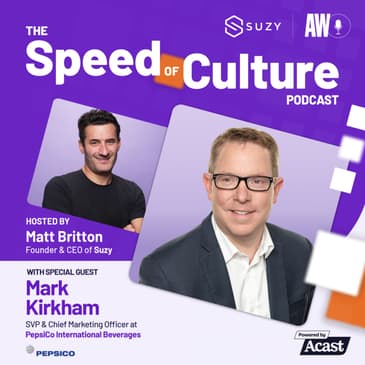
In this episode of The Speed of Culture, Matt Britton sits down with Mark Kirkham, SVP & Chief Marketing Officer at PepsiCo International Beverages. Mark shares how PepsiCo leverages AI to enhance consumer engagement, the importance of maintaining brand relevance, and the challenges behind balancing global consistency with local adaptation.
Follow Suzy on Twitter: @AskSuzyBiz
Follow Mark Kirkham on LinkedIn
Subscribe to The Speed of Culture on your favorite podcast platform.
And if you have a question or suggestions for the show, send us an email at suzy@suzy.com
Hosted on Acast. See acast.com/privacy for more information.
[00:00:02] [SPEAKER_00]: You know that you are a single-sweet journalist, a journalist who is a coffee and says a fleck.
[00:00:09] [SPEAKER_00]: No panic, a personal disc is a risk of the day, with their main form, both the hard-necked fleck.
[00:00:16] [SPEAKER_00]: For deep, a fish.
[00:00:18] [SPEAKER_00]: Just the disc is the dream and the rest, which makes your car a machine.
[00:00:22] [SPEAKER_00]: Because you always have your best, try the best discs from a fish.
[00:00:28] [SPEAKER_00]: You think about the number of data...
[00:00:37] [SPEAKER_02]: touch points we have, the number of direct to consumer and through partner and through
[00:00:42] [SPEAKER_02]: customer touch points at a large field company have. The question is, can we do it?
[00:00:47] [SPEAKER_02]: It's how do we do it in a scale way?
[00:00:51] [SPEAKER_01]: To thrive in a rapidly evolving landscape, brands must move in an ever-increasing
[00:00:55] [SPEAKER_01]: pace. I'm Matt Britain, founder and CEO of Suzy. Join me and key industry leaders as we dive deep into
[00:01:01] [SPEAKER_01]: the shifting consumer trends within their industry. Why it matters now and how you can keep up?
[00:01:06] [SPEAKER_01]: Welcome to the Speed of Culture.
[00:01:13] [SPEAKER_01]: Up today we're super excited to welcome Mark Perk come to the show, Mark CMO of PepsiCo
[00:01:18] [SPEAKER_01]: in a national beverages based over in Dublin, Ireland. Mark's been at PepsiCo for nearly 15 years now
[00:01:24] [SPEAKER_01]: really excited to get. Mark, thanks so much for joining today. Hey Matt, thanks for having me,
[00:01:28] [SPEAKER_01]: according to the chat. Absolutely. So one of the most common recurring themes that we see here at
[00:01:34] [SPEAKER_01]: the podcast is so many people who have risen the prominence in the marketing field,
[00:01:38] [SPEAKER_01]: put their key so to speak at PNG. And your background is no different. Tell us about your time
[00:01:44] [SPEAKER_01]: at PNG and what were some of the key learnings you were able to extract from that experience?
[00:01:48] [SPEAKER_02]: Look, I think it's a great test of it to PNG, all the people who've kind of come out of the ranks.
[00:01:52] [SPEAKER_02]: I actually wasn't born there and it grew up there. I came out of the gelette acquisition.
[00:01:57] [SPEAKER_02]: I was literally recruited by Gillette and hired by PNG back in 2005, 2006.
[00:02:02] [SPEAKER_02]: And I worked most of my career on what they call the legacy Gillette businesses, brown,
[00:02:06] [SPEAKER_02]: Dersel, some of the gelette work. And I think the one thing that you can always
[00:02:12] [SPEAKER_02]: PNG credit me, they were the first brand manager company in the world and they invented
[00:02:16] [SPEAKER_02]: the role back in the day. But the focus on brand building, the key fundamentals, the focus on
[00:02:23] [SPEAKER_02]: teaching and training. I think it's a foundation that a lot of marketers will get in,
[00:02:28] [SPEAKER_02]: in grad school, some marketers will get in just different experiences. And it was a very traditional
[00:02:34] [SPEAKER_02]: approach to kind of brand management and brand building skill. And I took a lot from that. I think
[00:02:39] [SPEAKER_02]: the other interesting thing is if you go back and now we're talking almost 20 years ago,
[00:02:43] [SPEAKER_02]: the world has also changed a lot. And so the type of experience and the type of marketers
[00:02:48] [SPEAKER_02]: develop, the type of companies people are coming from, it's so much more diverse. But I think all
[00:02:52] [SPEAKER_02]: of us who spent any time at PNG, whether they were grew up in the system, grew up in different parts
[00:02:57] [SPEAKER_02]: of PNG around the world or they were part of an acquisition. There's just something about
[00:03:01] [SPEAKER_02]: the learning agenda, the training and the kind of core focus on brand building that I think has helped
[00:03:07] [SPEAKER_01]: many of us throughout the careers. Yeah, for sure. And what you talk about brand management,
[00:03:11] [SPEAKER_01]: brand building, one things that struck me in recent years just that the notion of brand obviously
[00:03:15] [SPEAKER_01]: is changing as you mentioned, marketing itself in the entire world that we play and has changed so
[00:03:20] [SPEAKER_01]: much is brand more important now or less important now than it was when you entered PNG 20 years ago.
[00:03:27] [SPEAKER_02]: I think brand is more important than it ever has been. The question isn't is brand important,
[00:03:34] [SPEAKER_02]: is how to make brands important or it works at different, how to make brands relevant?
[00:03:39] [SPEAKER_02]: I think in the early stages of my career and over the history of kind of traditional CPG marketing,
[00:03:44] [SPEAKER_02]: the brand stood alone and the brand was the message and the mediums were more direct and
[00:03:49] [SPEAKER_02]: it was simpler. And you think about how brands engage and drive relevance today and I think about
[00:03:55] [SPEAKER_02]: portfolio, I manage a PepsiCo. It is far more complex. It is far more complicated. It is far more
[00:04:01] [SPEAKER_02]: interesting in many ways in terms of how we engage. So I think the role of the brand and what brand
[00:04:07] [SPEAKER_02]: stand for and how brands can build relationships and drive relevance with consumers is
[00:04:13] [SPEAKER_02]: probably more important today because there are so many different channels, distractions, competitors
[00:04:18] [SPEAKER_02]: that really change the landscape much more than it was even 20 years ago. And it's more how
[00:04:24] [SPEAKER_02]: do you build the relationship with brands today than maybe you did 10, 15, 25 years ago?
[00:04:30] [SPEAKER_01]: Yeah. I mean, you think about the barriers to create attention and on the Gen X,
[00:04:34] [SPEAKER_01]: or when I was growing up, the advent of the cable TV was a big deal. And the only way
[00:04:39] [SPEAKER_01]: you could really create mass scale was getting heavy rotation on a clear channel radio station
[00:04:45] [SPEAKER_01]: or obviously being on one of the big TV networks, etc. Individuals did not have the ability
[00:04:50] [SPEAKER_01]: to have a megaphone and smaller brands did. So really, the airways were dominated by large brands
[00:04:57] [SPEAKER_01]: and they got larger and larger. And many of them are still the largest brands today.
[00:05:01] [SPEAKER_01]: Is it possible for new mega brands to be created in this world where there is such fragmentation?
[00:05:06] [SPEAKER_02]: Well, I think the barriers sentry for brands is much lower than it was in the old days.
[00:05:10] [SPEAKER_02]: I'm a Gen X as well. And I think the traditional building ad create a key visual by some media
[00:05:17] [SPEAKER_02]: to marketing. It's gone. It's still part of our mix, but it's not essentially all you were
[00:05:23] [SPEAKER_02]: trained to do. So I do think it's possible. But I do think that while the various entry may have
[00:05:30] [SPEAKER_02]: gone down a bit for brands in different categories, the challenges and the skill sent. And I think
[00:05:36] [SPEAKER_02]: why those large scale CPG brands like PepsiCo and Pepsi and Gatorade and all of our brands
[00:05:42] [SPEAKER_02]: have the wear with all to stand touch the time is because we've learned to adapt.
[00:05:48] [SPEAKER_02]: We've learned to adapt in terms of how we communicate the channels we use, the engagement we play
[00:05:53] [SPEAKER_02]: and as you said, influencers, people are brands themselves. Our partners are brands themselves.
[00:05:59] [SPEAKER_02]: So I think the larger brands who have learned to adapt quickly and actually have found ways
[00:06:04] [SPEAKER_02]: to connect in new ways are the ones who will actually be able to really really continue to build
[00:06:08] [SPEAKER_02]: and build that kind of brand love and that relevance to consumers around the world.
[00:06:12] [SPEAKER_01]: Yeah, I think what's interesting is we talk about adapting especially in terms of how to get
[00:06:16] [SPEAKER_01]: the message out. Many times in recent years, what adapting means is going to the areas
[00:06:23] [SPEAKER_01]: that are dominated by the smaller players. If you think about a lot of the big brands that kind of
[00:06:28] [SPEAKER_01]: came out of nowhere in the early to mid 2000s, really were brands that took advantage of social media.
[00:06:34] [SPEAKER_01]: And then larger brands were saying, oh, well, if we just keep running linear television,
[00:06:37] [SPEAKER_01]: we're going to get lost. We need to go with a smaller businesses are. And a lot of ways
[00:06:42] [SPEAKER_01]: they have been able to dominate that space, but I think one of the challenges is how do you actually
[00:06:47] [SPEAKER_01]: do something social media or influencer content at scale, especially if new in a global position.
[00:06:53] [SPEAKER_01]: We can move now to your position at Pepsi. I think that customization and execution at scale
[00:06:58] [SPEAKER_01]: in something that was arguably built for more hand-to-hand combat is always a challenge for larger
[00:07:04] [SPEAKER_01]: companies and larger brands of portfolios like Pepsi Cup. I think there was a period of time
[00:07:09] [SPEAKER_02]: with the challenge for everybody. I would say it's an area, it's a space that's open to everybody.
[00:07:13] [SPEAKER_02]: And actually having scale may actually be an advantage. You think about the number of data touch
[00:07:19] [SPEAKER_02]: points we have, the number of direct to consumer and through partner and through customer touch
[00:07:24] [SPEAKER_02]: points at a large scale company half. The question isn't can we do it? It's how do we do it in a
[00:07:30] [SPEAKER_02]: way? And I think if you look at the example sale, we have capabilities that we call demand
[00:07:34] [SPEAKER_02]: accelerator. We fundamentally take our own first-party data, we take our customer data, we work with
[00:07:39] [SPEAKER_02]: third-party partners and data, and because of the scale of our company, we can actually
[00:07:43] [SPEAKER_02]: turn that around on our own instead of outsourcing personalized engines, we can actually create our own
[00:07:48] [SPEAKER_02]: engines. We can use technology to be an enabler for scale for our brands. And we're doing that.
[00:07:53] [SPEAKER_02]: For example, we do in Gatorade, we target athletes based on the occasions that in the types of
[00:07:59] [SPEAKER_02]: products that meet those occasions based on profiles we can make by triangulating data.
[00:08:03] [SPEAKER_02]: And we're doing that in scale markets like the US, but also in developing markets like Latin America.
[00:08:08] [SPEAKER_02]: And we're taking this combination of first-party third-party and partner data in many cases,
[00:08:13] [SPEAKER_02]: and actually pulling it together to create profiles, to create automated personas around
[00:08:18] [SPEAKER_02]: how we target content. And that will allow us to a flex our digital social skills and muscles,
[00:08:24] [SPEAKER_02]: even some of the programmatic that we bring in house will allow us to actually be much more
[00:08:28] [SPEAKER_02]: slicing messaging. And yes, while this was maybe a medium that started as kind of a low-barrier
[00:08:33] [SPEAKER_02]: to entry into the social media world, it's actually become a powerful tool to drive scale,
[00:08:38] [SPEAKER_02]: just as TV did 20, 30 years ago. So I think we're at a unique point in time where I think the
[00:08:44] [SPEAKER_02]: playing field is equal. The question is who's got the powerful brands and who's got the
[00:08:49] [SPEAKER_02]: powerful data and capabilities to actually make the most of it at scale? Yeah, I'm glad you mentioned
[00:08:55] [SPEAKER_01]: data, because that's obviously especially in the world of AI. The secret ingredient,
[00:08:59] [SPEAKER_01]: everybody is going to have access to these large language models and new AI technologies,
[00:09:03] [SPEAKER_01]: and what's going to differentiate brands and companies in terms of how they activate is the data
[00:09:07] [SPEAKER_01]: that they bring to the table. Pepsi traditionally is a company that sold its brands through big
[00:09:13] [SPEAKER_01]: box retailers, third parties, and hasn't had the advantage of first-party data. Well, I got
[00:09:18] [SPEAKER_01]: to accomplish it sell the rap, but I know in recent years given the growing importance of first-party
[00:09:22] [SPEAKER_01]: data, Pepsi's done a lot of work at getting its hands on all sorts of data, first and zero
[00:09:28] [SPEAKER_01]: party data from your customer-based keytopical to the about some of those efforts. Yeah, if you think
[00:09:32] [SPEAKER_02]: about it, just to move to digital and social, whether it's through your own apps, your partner
[00:09:37] [SPEAKER_02]: apps, through existing online media platforms, well we don't have access to first-party data in all
[00:09:42] [SPEAKER_02]: cases. We have access to the ability to profile, to the ability to understand, behavior across platforms,
[00:09:49] [SPEAKER_02]: that we never did before. And if you think about how we're able to target through the right messaging,
[00:09:55] [SPEAKER_02]: working with partners, I mean think about some of our way from home or we call the food service
[00:09:59] [SPEAKER_02]: customers. We can actually do very specific deals through their customers, with working with them
[00:10:05] [SPEAKER_02]: in their data. Sometimes directly having access to data in other cases, just working with shared profiles.
[00:10:10] [SPEAKER_02]: The other thing we actually can do is actually work through aggregators. Think about the door
[00:10:14] [SPEAKER_02]: dashes, the grown homes as well. Now again, customers like that may not share all their data
[00:10:19] [SPEAKER_02]: with us, but they have data that allows us to actually better target to better look at different
[00:10:23] [SPEAKER_02]: meal occasions and understand what's right for our brand. And then there's the data we have
[00:10:27] [SPEAKER_02]: internally. I'll give you a great example. We have a group of then Gatorade called GSSI, Gatorade
[00:10:32] [SPEAKER_02]: Sports Science Institute. It is literally the nutritional science and the experts within our sports
[00:10:37] [SPEAKER_02]: nutrition field. Now they produce publicly available reports all the time through industry association,
[00:10:43] [SPEAKER_02]: academic association, and we have tons of data knowledge. Most recently, we took that and used AI
[00:10:50] [SPEAKER_02]: to create an avatar. We call her an answer to the sake of giving her a name, but we're using it
[00:10:55] [SPEAKER_02]: for education in just to also kind of bring to life these reams and years of research in a really
[00:11:02] [SPEAKER_02]: relevant way. We launched it at Sports Beach at Kenyan a couple weeks ago. And this appetite
[00:11:06] [SPEAKER_02]: literally allows you to ask simple questions. Hey, I'm going for a 5K today. How many electric
[00:11:10] [SPEAKER_02]: lit today? What's the best solution for me or what should I be thinking about my first work out?
[00:11:15] [SPEAKER_02]: This ability to take data, which was our data. And now be able to interact through AI and actually
[00:11:21] [SPEAKER_02]: capture responses and actually learn by the responses of great creates new ways to take make
[00:11:26] [SPEAKER_02]: really powerful tools and messages around research that is super consumer relevant. In the past,
[00:11:34] [SPEAKER_02]: it would have been handed out at different forums and it would be available online. But now we
[00:11:38] [SPEAKER_02]: created a way to kind of educate and engage. And I think that's how data is changing the engagement
[00:11:44] [SPEAKER_01]: story from marketing. It's interesting because we mentioned earlier how brands are people and people
[00:11:49] [SPEAKER_01]: are brands. And really what you're doing through an activation like this is you're really personifying
[00:11:54] [SPEAKER_01]: the get-to-rate brand and allowing people to talk to it. And I wonder what your thoughts are,
[00:11:59] [SPEAKER_01]: is that the future, obviously, we can't pigeonhole into one area. But if you think about
[00:12:04] [SPEAKER_01]: the opportunities that exist in scaling out a strategy like that where you can talk to Pepsi
[00:12:09] [SPEAKER_01]: brands, you could talk to Mountain Dew, Face to Pine, whatever genre or type of consumer it goes
[00:12:15] [SPEAKER_01]: after and get information and bring the content and brand the life. That seems like a fascinating
[00:12:19] [SPEAKER_02]: approach. Look, I think the world will continue to evolve in a more automated space but behind each
[00:12:25] [SPEAKER_02]: one of those ideas and automations are real people. And I think that's the one thing that
[00:12:30] [SPEAKER_02]: in the debate around AI, creativity comes from ideas that are concepted, not to sit back to you
[00:12:37] [SPEAKER_02]: and chat GPT. And I do believe that as we evolve, as we become more integrated in terms of
[00:12:43] [SPEAKER_02]: creative development and the using technology and tools like AI, what I ultimately believe is
[00:12:48] [SPEAKER_02]: think about when chatbot first started, think about when voice recognition, remember when net
[00:12:52] [SPEAKER_02]: first time you call them airline and an automated voice asked you for your information. And we know
[00:12:56] [SPEAKER_02]: that behind that, you would always hit star million times and you get to a real person. So I think
[00:13:01] [SPEAKER_02]: the reality is technology enables us to be more efficient, technology enables us to be more accurate,
[00:13:08] [SPEAKER_02]: but technology is only as powerful as the people in the creative behind it. And the example I just
[00:13:12] [SPEAKER_02]: gave you is a perfect example of great science done by real people brought to life through an amazing
[00:13:17] [SPEAKER_02]: institute called GSSI and brought to life through technology so more people have access to it.
[00:13:22] [SPEAKER_02]: They can learn more, they can educate, they can learn about their own health and wellness, but also
[00:13:27] [SPEAKER_02]: we do it in a way that feels, well, it may be AI or it may be an avatar. It actually feels like
[00:13:34] [SPEAKER_02]: you're having a conversation and I think this idea of having conversations and brands,
[00:13:38] [SPEAKER_02]: that's what technology enables because one way conversation through traditional media
[00:13:42] [SPEAKER_02]: have a role to play at driving awareness in scale. But what they can't do is build that engagement
[00:13:48] [SPEAKER_02]: relationship and you see that more and more as we look to leverage both new platforms, new channels
[00:13:53] [SPEAKER_01]: and new technologies. Yeah, when you talk about scalability, I mean what used to mean bringing
[00:13:58] [SPEAKER_01]: a brand the life through personification was a brand's Twitter handle where you would kind of
[00:14:03] [SPEAKER_01]: reply and we went through that whole era where brands were talking to be a Twitter. Now there's
[00:14:06] [SPEAKER_01]: so much of a scalable and I think what makes that activation that you just described possible is the
[00:14:11] [SPEAKER_01]: you had GSSI. So you had all this data and kind of this rich treasure trove of insights that
[00:14:18] [SPEAKER_01]: you were able to sort of unpack into essentially a brain that you can impart to wisdom into consumers.
[00:14:23] [SPEAKER_01]: And I think what I'm learning over time is the brands that have invested over time in research
[00:14:28] [SPEAKER_01]: in custom content will now they can cap into that to make their AI applications really unique and
[00:14:34] [SPEAKER_02]: critical to their brains. On a percent, and it's also part of storytelling just another quick
[00:14:39] [SPEAKER_02]: example and it's a difference, another gay to table about two, three months ago we created
[00:14:43] [SPEAKER_02]: piece of content that was based on a grassroots program what we call confidence coaches.
[00:14:48] [SPEAKER_02]: Now confidence coaches, we have a looking called five V5, it's a five-aside soccer or football
[00:14:52] [SPEAKER_02]: tournament. That's had 151,000 kids participate in the last five or seven years and we were
[00:14:58] [SPEAKER_02]: giving confidence to young kids. We know that 40% of most young athletes quit because of variety
[00:15:03] [SPEAKER_02]: things, cause safety but actually confidence one of the biggest ones and it's even worse for
[00:15:08] [SPEAKER_02]: young female athletes and it was an amazing footballer played for England played for Arsenal.
[00:15:13] [SPEAKER_02]: And she always told the story about how when she was nine years old, she had a cutter hair
[00:15:16] [SPEAKER_02]: to play with the boys. Okay? Now you can tell that story and people could relate to it but
[00:15:21] [SPEAKER_02]: until you picture it, until in this case we use technology and AI to recreate Rachel Yonky's
[00:15:27] [SPEAKER_02]: nine-year-old self so she could have a conversation about the barriers that she had in the confidence
[00:15:32] [SPEAKER_02]: that she had to overcome and then let her tell her story to other young girls as they place for it.
[00:15:38] [SPEAKER_02]: That is leveraging technology and data but it all started with a human-centric idea like
[00:15:44] [SPEAKER_02]: Rachel had a real story and we just made it more engaging. We just made a different angle to her.
[00:15:50] [SPEAKER_02]: I mean when I was with her and she's watching this for the first time, you see the emotional
[00:15:55] [SPEAKER_02]: connection that even technology can have but it could not have gone anywhere if we didn't have
[00:16:00] [SPEAKER_02]: that story to begin with. So technology, Apple 5 creativity, it created new retail stories but
[00:16:05] [SPEAKER_02]: ultimately when you're trying to build that emotional connection, it still has to be that authentic
[00:16:09] [SPEAKER_01]: kind of fielded in the heart kind of moment. Yeah, well it is the heart but while AI might be
[00:16:14] [SPEAKER_01]: the brain, the heart is the human component, it's the emotional component where you don't feel like
[00:16:19] [SPEAKER_01]: you're talking to a robot or pressing zero in million times to get to it human. If you can inject
[00:16:23] [SPEAKER_01]: both right then you really win and you bring the brand along for a story that creates engagement
[00:16:27] [SPEAKER_01]: like we've never seen before. Absolutely. We'll be right back with the speed of culture
[00:16:31] [SPEAKER_01]: after a few words from our sponsors.
[00:17:06] [SPEAKER_01]: So you've been at PepsiCo now since 2010, so it's 15 years and as you mentioned a whirlwind
[00:17:11] [SPEAKER_01]: of change that occurred over the last decade and a half. Talked about your journey at PepsiCo
[00:17:16] [SPEAKER_01]: and what has been so appealing about that organization that's made you stay there and rise up to
[00:17:21] [SPEAKER_01]: ranks to where your art today is a CMO of International Leverages. I think the first thing I'll say
[00:17:26] [SPEAKER_02]: and it may sound cliche but it's 100% true is culture. Culture defines not just a job
[00:17:32] [SPEAKER_02]: and not just an office. It defines the community in which you work. I joined in 2010, I left
[00:17:37] [SPEAKER_02]: PNG, came to PepsiCo and I went into innovation in the U.S., and the reality is innovation in a
[00:17:44] [SPEAKER_02]: CPG company like PepsiCo actually it's a much more fast turning than you realize because of the
[00:17:49] [SPEAKER_02]: category dynamics that we play in but very very consumer oriented, very very system driven, really
[00:17:55] [SPEAKER_02]: focusing on how to get an idea to market as quickly as possible and that to me was a really
[00:18:00] [SPEAKER_02]: exciting time because you were in this big company doing innovation some of the big,
[00:18:05] [SPEAKER_02]: some of them small but you had a cycle that was pretty dynamic. But then around 2012 we created
[00:18:10] [SPEAKER_02]: the global groups which we were originally, I was usually base here and it was actually the first
[00:18:15] [SPEAKER_02]: time that PepsiCo had really taken a global approach in terms of marketing and brand building and when
[00:18:21] [SPEAKER_02]: I say that we hadn't structured for it like many companies do the PNG for world example or even
[00:18:28] [SPEAKER_02]: when I was on the gelette side very global in nature and what we saw was how you can actually
[00:18:34] [SPEAKER_02]: learn from it, build from the different dynamics around the world. And so I spent a lot of time
[00:18:39] [SPEAKER_02]: from 2012 to 2016 running big global brands like Pepsi and Mountain Dew and really understanding
[00:18:45] [SPEAKER_02]: the different dynamics around the world and if purchase added a purchase, can't go at us.
[00:18:49] [SPEAKER_02]: Originally other purchase yeah and out of New York and then what I actually got the opportunity
[00:18:53] [SPEAKER_02]: 2016 to go abroad, not only I lived abroad a couple different times I got on the school in the UK,
[00:18:59] [SPEAKER_02]: I got to spend time really going deep and so for me the culture then goes into understanding the
[00:19:05] [SPEAKER_02]: markets, their market cultures, the market dynamics and this is the culture of the people,
[00:19:11] [SPEAKER_02]: the culture of the business and the world in which those brands operate and that's what we have
[00:19:14] [SPEAKER_02]: to figure out the balance between global scale and local relevance especially in today's world
[00:19:19] [SPEAKER_02]: and digital and channels are so much more locally presented. We talked about personalization,
[00:19:26] [SPEAKER_02]: really understanding the dynamics from Mountain Dew and India. Mountain Dew is the second brand
[00:19:30] [SPEAKER_02]: from Mountain Dew in the world is India and it's the biggest often we have it's massive,
[00:19:34] [SPEAKER_02]: massive business for us but the dynamic there it's not the same is what you had when I was a kid
[00:19:38] [SPEAKER_02]: and you burned North Carolina and so you learned to understand the role that these brands play,
[00:19:43] [SPEAKER_02]: the role that the product plays and so from 2016 and beyond I've been basically working in
[00:19:49] [SPEAKER_02]: international roles and came back and took over a juice and energy businesses I've taken over
[00:19:53] [SPEAKER_02]: CMO for the last two and a half years and what's made it really amazing and it's always
[00:19:58] [SPEAKER_02]: you're always learning because every time there's a new dynamic there's a new market,
[00:20:02] [SPEAKER_02]: there's a new competitor, there's a new category trend and when you look at it there is no average
[00:20:08] [SPEAKER_02]: you want to scale to be globally kind of consistent and especially for iconic brands,
[00:20:14] [SPEAKER_02]: CFC, Gatorade, Mountain Dew and others but you need to find the way to be local relevant.
[00:20:19] [SPEAKER_02]: So you do that through influencers, you do that through local relevant messaging,
[00:20:22] [SPEAKER_02]: you do that through adapting communication to work in different ways, you do it some cases through
[00:20:27] [SPEAKER_02]: innovation but ultimately still has to be the same brand so the challenge you have as a global
[00:20:32] [SPEAKER_02]: marketer is how can I drive global scale because you got these amazing multi-billion dollar
[00:20:37] [SPEAKER_02]: powerful brands with long histories and really unique distinctive assets but making them really
[00:20:43] [SPEAKER_02]: relevant whether you're in luck know in India or you're in South Paulo, Brazil or you're in Chennai
[00:20:49] [SPEAKER_02]: you've got to find a way to kind of find that balance and that to me is one of the most exciting
[00:20:54] [SPEAKER_02]: parts and why I've really enjoyed the last set of an eight and a half years outside the US
[00:20:59] [SPEAKER_02]: and it's a really powerful learning experience that ultimately you can take anywhere you go
[00:21:05] [SPEAKER_02]: and when you take that learning it doesn't matter if you take it back to a domestic roll
[00:21:09] [SPEAKER_02]: you take it to a local role understanding those nuances I think makes you a stronger marketer
[00:21:14] [SPEAKER_02]: and last thing I'll say is that the heart of everything is human beings. The one of the things
[00:21:18] [SPEAKER_02]: that I've also learned in taking so much fits so special to me is just getting to talk to and
[00:21:24] [SPEAKER_02]: learn from consumers around the world, understanding the delivery driver in Seoul, the mom from
[00:21:30] [SPEAKER_02]: by the restaurant touring in Mexico City, whatever it is I've learned so much about human beings
[00:21:36] [SPEAKER_02]: as well as what it means to be a marketer just by being close to those people throughout the
[00:21:40] [SPEAKER_01]: last 15 years of PepsiCo. Yeah I mean when the amazing experience I mean you can speak about it
[00:21:45] [SPEAKER_01]: sort of matter of factly but the decision that you made in 2016 to go from a senior director of
[00:21:52] [SPEAKER_01]: marketing role and purchase New York for Pepsi to go to London to be head of marketing innovation
[00:21:58] [SPEAKER_01]: I mean that's a big decision to actually move across the pond and move out of the United States
[00:22:03] [SPEAKER_01]: like what went behind the decision like that and what were some of the biggest surprises you encountered
[00:22:08] [SPEAKER_01]: when you started working overseas. You talked about all the great things that were unlocked
[00:22:12] [SPEAKER_01]: but were there any surprises or things that you had to deal with? So first off I'm half English
[00:22:16] [SPEAKER_02]: my dad's English so going and I went to school in the UK so it was a little bit of a softer landing
[00:22:20] [SPEAKER_02]: I guess. The second thing I'll say I would encourage anyone that has the ability in the opportunity
[00:22:25] [SPEAKER_02]: to go abroad whether in uni or in your professional you should. Why? Because it opens your eyes
[00:22:31] [SPEAKER_02]: up to new dynamics and it's a different business dynamics, it's different cultural dynamics,
[00:22:36] [SPEAKER_02]: retail, whatever and for me personally it was also the first time I'd worked in a national
[00:22:40] [SPEAKER_02]: and traveled and experienced so much before was first from abroad my family and so it was great
[00:22:44] [SPEAKER_02]: to bring my family have them experience the culture experience something that was part of who I am
[00:22:48] [SPEAKER_02]: and ultimately when they are in English culture in the US culture are more similar but because we were
[00:22:53] [SPEAKER_02]: they were able to travel to different parts of the world whether it's the Middle East or whether it
[00:22:58] [SPEAKER_02]: was Thailand, what have you? Now on the business side the interesting thing is you learn
[00:23:03] [SPEAKER_02]: especially when you come from the US so you have to so big and broaden glass and there's so
[00:23:08] [SPEAKER_02]: much opportunity here to learn but you realize that in every country and by our biggest
[00:23:12] [SPEAKER_02]: side there's so much opportunity for your brands and in Europe some of our brands are more
[00:23:16] [SPEAKER_02]: challenged your brands so how you can act differently and how you can approach channels
[00:23:21] [SPEAKER_02]: differently and how you can imprage brand building differently because of those local dynamics
[00:23:25] [SPEAKER_02]: is probably the first thing you have to adapt to. What is different about West Europe versus East
[00:23:30] [SPEAKER_02]: Europe, the UK versus Italy? What is the category? How can I still build this campaign
[00:23:35] [SPEAKER_02]: that resonates across these different market types in Europe in particular again?
[00:23:39] [SPEAKER_02]: The great example where people average Europe to being the EU or Europe, Europe is vastly dynamic
[00:23:45] [SPEAKER_02]: even just within itself so I think you learn also how to stretch yourself. I think one of the things
[00:23:50] [SPEAKER_02]: you go in there is thinking you understand things and then you realize oh my god these people
[00:23:55] [SPEAKER_02]: have forgotten more than you've ever learned so you have to listen you have to take the time to
[00:23:59] [SPEAKER_02]: immerse you consumers retailers we also operate in a franchise environment in many parts outside
[00:24:05] [SPEAKER_02]: the US so I work with bottlers around the world so my partners in many cases I'm two three steps
[00:24:10] [SPEAKER_02]: away from the end consumer so actually your skills of building relationships with bottlers
[00:24:15] [SPEAKER_02]: and retailers and media companies all of that just open your eyes up to a whole new dynamic and for me
[00:24:22] [SPEAKER_02]: it was kind of something I always wanted to do and actually really get your hands dirty but
[00:24:27] [SPEAKER_02]: at the same time is how you take those skills that you can learn sometimes in a smaller market
[00:24:33] [SPEAKER_02]: and then ultimately bring it back to bigger markets around the world and so how we can
[00:24:36] [SPEAKER_02]: list and scale and lift and adapt ideas I think that's the power of having these kind of experiences
[00:24:41] [SPEAKER_02]: it's different but also it's the same and the same is what this is what brand buildings all
[00:24:47] [SPEAKER_02]: about understanding your consumer understanding your brand and knowing where you have the right
[00:24:52] [SPEAKER_01]: to succeed in an authentic way that's right couldn't agree more of that and global new ones is
[00:24:58] [SPEAKER_01]: aside going from market to market are there any kind of macro trends that are impacting the
[00:25:02] [SPEAKER_01]: categories in which you plan that you have your eye on moving forward as we enter that path of 2024
[00:25:07] [SPEAKER_02]: yeah I mean one of the things especially is I look internationally but my time in Europe I mean
[00:25:12] [SPEAKER_02]: our no sugar business were over two thirds no sugar no one was sugar in Europe and that was
[00:25:16] [SPEAKER_02]: something we were very focused on the category dynamics are different consumer dynamics are changing
[00:25:20] [SPEAKER_02]: in some case faster than other parts of the world so it was a great opportunity to really learn
[00:25:25] [SPEAKER_02]: both from a portfolio standpoint from a consumer standpoint what is the right set of products
[00:25:30] [SPEAKER_02]: that they are looking for when we call it Pepsi Max and UK but Pepsi zero sugar it's an amazing
[00:25:35] [SPEAKER_02]: brand so over 30 years but we made some really really important choices we went all in a 100%
[00:25:41] [SPEAKER_02]: focusing on just zero sugar communication we helped build the category many markets we got leadership
[00:25:46] [SPEAKER_02]: in many markets versus in other parts of the world it's a smaller piece of portfolio that learning
[00:25:51] [SPEAKER_02]: you can extract and take into other parts of world the context might be different but the foundations
[00:25:56] [SPEAKER_02]: they say understanding consumer what are they overall kind of taste trends what are they're all
[00:26:05] [SPEAKER_02]: something we've taken I think the other thing is how you actually think about the retail landscape
[00:26:10] [SPEAKER_02]: when you start to think about international markets you have to think about what we call traditional
[00:26:15] [SPEAKER_02]: trade we're talking about bodegas small shops up and down the street how you communicate consumers
[00:26:21] [SPEAKER_02]: when you're literally in a stall this big we build great big campaign messages but it doesn't
[00:26:27] [SPEAKER_02]: matter unless it lands on that shelf and that small stall in that country that's far away and so
[00:26:33] [SPEAKER_02]: I think understanding the market dynamics of how do you think about marketing differently
[00:26:37] [SPEAKER_02]: you know I've talked to one of our botellers in Pakistan he's saying his customers all get
[00:26:41] [SPEAKER_02]: everything on their phone and we're talking about customers who may be much older than you know
[00:26:45] [SPEAKER_02]: we think they're targeting we're literally engaging consumers in new way we have a partnership with
[00:26:50] [SPEAKER_02]: Amber and Brazil they do almost most of their order through a platform they call bees it's amazing
[00:26:54] [SPEAKER_02]: how they're interacting with all their shopkeepers so there's an opportunity to really learn from
[00:27:00] [SPEAKER_02]: technology differences in different parts of the world category dynamics and also sustainability
[00:27:05] [SPEAKER_02]: I mean living in Europe we've really been focused on some of the challenges and regulations
[00:27:09] [SPEAKER_02]: and sustainability it allows us to really learn and lift and shift to other parts of the world
[00:27:13] [SPEAKER_02]: and we've done some great progress going to 100% our pet and actually really focusing on
[00:27:18] [SPEAKER_02]: reuse and recycle these are the types of things where when you live in certain parts of the world
[00:27:23] [SPEAKER_02]: or you see different dynamics you fundamentally change maybe your perception of how you approach
[00:27:28] [SPEAKER_01]: challenge or a problem as a marketer absolutely and so it sounds like your role is
[00:27:32] [SPEAKER_01]: fairly complex with even different business models that you're operating whether it's a franchise
[00:27:37] [SPEAKER_01]: model or the more traditional model which you have here in North America given all that how do you
[00:27:43] [SPEAKER_01]: spend your time both when you're kind of working in the business and on the business and what I mean
[00:27:48] [SPEAKER_01]: by that is there's obviously a portion of time that you have to spend given how much global
[00:27:51] [SPEAKER_01]: knowledge you have about just learning and keeping your ear to the ground understanding the consumer
[00:27:56] [SPEAKER_01]: markets and obviously you're operating a team and you have numbers to hit etc for your business
[00:28:00] [SPEAKER_01]: so given all that where you invest in your time and where you investing elements of personal growth
[00:28:05] [SPEAKER_01]: and make sure that you obviously continue to develop as a professional. You've brought up a key
[00:28:09] [SPEAKER_02]: point which is learning and made a comment once that my team reminds me it's like the day I
[00:28:13] [SPEAKER_02]: stopped learning it's the day I stopped being a marketer and I mean that because as a marketer
[00:28:18] [SPEAKER_02]: you should be fundamentally curious you should be always looking to understand your consumer better
[00:28:23] [SPEAKER_02]: you should always be understanding the impact that has on your business and I do mean this
[00:28:28] [SPEAKER_02]: and because of that you have to still have even at my level and in my busy schedule you need to
[00:28:33] [SPEAKER_02]: take time to understand the consumer talk to consumers and I think every one of us these so always
[00:28:38] [SPEAKER_02]: carve out some time for spending time with consumers and sometimes consumers should be your friends,
[00:28:43] [SPEAKER_02]: your friends, kids it could be anyone but as a consumer because ultimately we're all consumers at the
[00:28:47] [SPEAKER_02]: end of the day but more importantly we're all human beings and we all have different wants needs
[00:28:52] [SPEAKER_02]: and context of the world around us. The second thing is you're also going to carve out time
[00:28:56] [SPEAKER_02]: to shake and I don't think we do enough of that. I color code my calendar, I've done it for
[00:29:02] [SPEAKER_02]: long time and I'm going to do it by brand or by different type of business meetings but I also use
[00:29:06] [SPEAKER_02]: the color black and I block out and it says block but that's my thinking time. You need to make
[00:29:11] [SPEAKER_02]: sure you carve out time to think because not that you're not always constantly thinking but that
[00:29:16] [SPEAKER_02]: dedicated moment that hour that half hour even 15 minutes sometimes will allow you to kind of
[00:29:21] [SPEAKER_02]: challenge your perception maybe open up to new ideas maybe look at a different category for a moment
[00:29:27] [SPEAKER_02]: that you hadn't thought about so I think carving out time the other thing I said misconduct
[00:29:31] [SPEAKER_02]: ties to the earlier conversation you got to get into the market you got to understand and this isn't
[00:29:36] [SPEAKER_02]: just about understanding the humans and the business but it the teams really understanding the culture
[00:29:41] [SPEAKER_02]: of the teams you work with what drives and what motivates them what worries them what's going on in
[00:29:47] [SPEAKER_02]: their world that you may not be able to help in everything you do but even just understanding
[00:29:51] [SPEAKER_02]: having the context and being able to step back and say I understand the challenges
[00:29:55] [SPEAKER_02]: or the opportunities that you face how can I help that's a big play and I think that you have to
[00:30:00] [SPEAKER_02]: bring it outside in so for example in our office in Dublin we have 32 different nationalities
[00:30:06] [SPEAKER_02]: okay our core teams 85 people so 30 say internationalities and 85 people that dynamic creates
[00:30:13] [SPEAKER_02]: such an amazing environment for my teams people from the US to Pakistan to Russia to Latin America
[00:30:19] [SPEAKER_02]: Venezuela like you've got so many chances to interact with people from all over the world in a
[00:30:25] [SPEAKER_02]: floor you know that you know the size of a football field and so having that ability to learn
[00:30:30] [SPEAKER_02]: for each other share is really really important and then the last thing I say is just be open
[00:30:37] [SPEAKER_02]: and create opportunities for people to share and I think we are always busy but sometimes
[00:30:43] [SPEAKER_02]: you go step back and just ask a question around hey what do you guys up to what are you working on
[00:30:48] [SPEAKER_02]: what is the biggest challenge of the day give people that open door to come to you because
[00:30:54] [SPEAKER_02]: we're busy but making the time to understand what regardless of level someone's working on
[00:31:00] [SPEAKER_02]: or where they want to go in their career I mean this fall of the office is a better
[00:31:04] [SPEAKER_02]: I'm lucky we've got about 3000 people throughout Ireland but our core international business
[00:31:08] [SPEAKER_02]: team is marketing is just about 88 and five but just having that time so you really making the time
[00:31:14] [SPEAKER_02]: organizing your schedule and way to make sure you have to think be with consumers and your
[00:31:19] [SPEAKER_02]: markets those are the things that I think make you successful I think if you do that and you know
[00:31:23] [SPEAKER_02]: your business all the other things all the leadership meetings all the kind of more business
[00:31:28] [SPEAKER_02]: focus things it just makes you have more valuable in those sessions if you do the other things
[00:31:33] [SPEAKER_01]: absolutely and we talked a lot about AI as a wrap up here and how it's going to impact so many
[00:31:38] [SPEAKER_01]: aspects of society and obviously the marketing world one part I think it shouldn't be impacting
[00:31:43] [SPEAKER_01]: probably take a while for it to impact is just how younger people are educated because the notion
[00:31:48] [SPEAKER_01]: of memorizing things for a test and re-urgitating it is going to be a skill set that's far less
[00:31:53] [SPEAKER_01]: valuable in this new AI driven world that may be in the past so the question I have for you is
[00:31:59] [SPEAKER_01]: what should young people whether they're college age or later in their high school years if they
[00:32:04] [SPEAKER_01]: want to end up as a CMO one day like yourself what should they be focused on learning and developing
[00:32:09] [SPEAKER_01]: their skills at earlier phase of their career or their journey I would say don't let a computer
[00:32:14] [SPEAKER_02]: do the learning for you be the first thing I would say and this is not a comment about AI it's a
[00:32:19] [SPEAKER_02]: comment of what does it take to truly learn when Clich notes came out that was like the end of
[00:32:25] [SPEAKER_02]: reading a book that didn't turn up in the case so when Google came out that was going to make
[00:32:29] [SPEAKER_02]: research and uses people still go to libraries when the mobile phone came out oh that was going to
[00:32:34] [SPEAKER_02]: kill the TV so people are watching TV and AI isn't a naveler for so many things many companies
[00:32:40] [SPEAKER_02]: around the world we've been using AI in the back of house for years right having to look
[00:32:43] [SPEAKER_02]: in logistic, heavily in forecasting and planning but now I think the interesting it's impacting
[00:32:47] [SPEAKER_02]: on the front end of consumers and so I think it's soon to be college age jolter she's a senior
[00:32:53] [SPEAKER_02]: in high school and look technology helps her hone her skills but studying experiencing life
[00:33:00] [SPEAKER_02]: running for clubs doing all those things which by the way universities care a ton about
[00:33:06] [SPEAKER_02]: is almost more important than any tool of technology that helps you maybe understand something
[00:33:12] [SPEAKER_02]: in a less linear way I think style of learning has changed a lot too we had a very different
[00:33:17] [SPEAKER_02]: style when we grew up and was probably more structured it was probably more linear it probably
[00:33:22] [SPEAKER_02]: was more memorization but these are actually students who now through experience and because of
[00:33:27] [SPEAKER_02]: they can go watch a surgery via zoom my daughter literally watched the surgery via zoom
[00:33:33] [SPEAKER_02]: during COVID in Ireland in LA someone was doing a surgery and that's what inspired her to become a
[00:33:39] [SPEAKER_02]: doctor now she wants to be a doctor because of things like that so that technology enabled
[00:33:44] [SPEAKER_02]: something that couldn't have existed when you and I grew up but it didn't replace the experience
[00:33:49] [SPEAKER_02]: or the kind of curiosity that my daughter has or that the technology enabled so like any other
[00:33:56] [SPEAKER_02]: technology before maybe this one's a little bit different maybe this one offers different characteristics
[00:34:00] [SPEAKER_02]: and maybe allows for more powerful outputs but actually the inputs are as important if not
[00:34:07] [SPEAKER_02]: more important than the outputs when it comes to these things as fantastic advice and then I
[00:34:12] [SPEAKER_01]: agree with you across the board in terms of just the core drivers that make somebody successful
[00:34:17] [SPEAKER_01]: and you can't lose that no matter what the technology is so it's almost like the more things
[00:34:21] [SPEAKER_01]: change and where they stay the same you can serve the best way to summarize that so it's a finish up
[00:34:25] [SPEAKER_01]: mark and this has been a great discussion I can't wait for our listeners to hear it
[00:34:29] [SPEAKER_01]: is there a quarter of a mantra that you like to live by you share it so much wisdom with us today
[00:34:32] [SPEAKER_01]: that I don't know if you could bottle a lot in a sentence or not but I figured we give it a try
[00:34:36] [SPEAKER_02]: I think I said it earlier about this idea the day you stopped learning it's a day you stopped
[00:34:40] [SPEAKER_02]: being a marketer I mean it's not even just about being a marketer it's a day stop learning
[00:34:44] [SPEAKER_02]: I don't think you'll ever be the person that you could ultimately be I think also finding that kind of
[00:34:55] [SPEAKER_02]: always give credit to a writer James Curry wrote a book about the all blacks and what business
[00:35:01] [SPEAKER_02]: is learning all blacks and it's a mantra that the all blacks the New Zealand rugby team has which
[00:35:05] [SPEAKER_02]: is always leave the shirt in a better place than where you found it and it's a sport analogy
[00:35:10] [SPEAKER_02]: but it can go through anything in life we can go as a kid it goes leader it can go as a teacher
[00:35:15] [SPEAKER_02]: this idea that I've this amazing opportunity to run these amazing brand and I'm just trying to make
[00:35:21] [SPEAKER_02]: better for the next person who gets to take them over after me and if I make success in doing that
[00:35:26] [SPEAKER_02]: and I learn along the way I've had a hell of a career I love that we're going to leave with that thank you
[00:35:31] [SPEAKER_01]: so much for joining us today Mark and I really cannot wait for already into here from your journey
[00:35:36] [SPEAKER_01]: in your wisdom so thanks again thanks Mark appreciate it all be happy to see you again
[00:35:40] [SPEAKER_01]: to be keen thanks again to Mark Kirkham CMO at Peppercut International beverages for joining us today
[00:35:45] [SPEAKER_01]: be sure to subscribe right review to speed of culture podcasts on your favorite podcast platform
[00:35:48] [SPEAKER_01]: so next time see you soon everyone take care
[00:36:40] [SPEAKER_00]: you know that you're a professional fan of the club's channel
[00:36:43] [SPEAKER_00]: a lovely shirt on the top of the coffee and say a flick no panic
[00:36:48] [SPEAKER_00]: a pair of masks every day with their craftform forms besides themselves the hard-nackees
[00:36:54] [SPEAKER_00]: flaking for deep rain a few the discs in the trommel and the rest that's
[00:36:59] [SPEAKER_00]: a washing machine because you always have your best there are now the best discs of a pair of
[00:37:05] [SPEAKER_00]: and the other side of the children are also used.