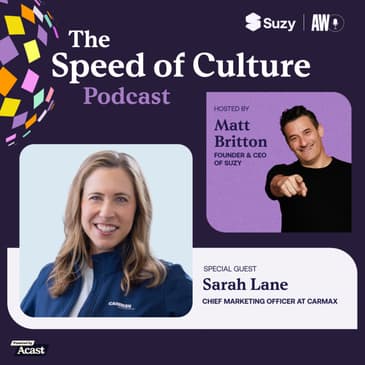
Sarah Lane, Chief Marketing Officer at CarMax, joins Matt Britton on the Speed of Culture podcast to detail how the brand transformed the automotive retail experience through transparency and a commitment to women’s sports. Sarah explains the journey from local team sponsorships to high-profile national partnerships with the WNBA and NBA, highlighting how authentic fan engagement builds lasting trust. The conversation also covers the impact of emerging technologies like Large Language Models on the car-buying process.
Follow Suzy on Twitter: @AskSuzyBiz
Follow Sarah Lane on LinkedIn
Subscribe to The Speed of Culture on your favorite podcast platform.
And if you have a question or suggestions for the show, send us an email at suzy@suzy.com
Hosted on Acast. See acast.com/privacy for more information.
[00:00:00] I think at the core is like having a great brand identity. So CarMax was the original disruptor, bringing fairness to this industry that was really taking advantage of consumers all along the way. And having that core along the entire way with us, always being able to harken back to that while all the change is happening around us has been a tremendous benefit. To thrive in a rapidly evolving landscape, brands must move at an ever increasing pace. I'm Matt Britton, founder and CEO of Suzy.
[00:00:28] Join me and key industry leaders as we dive deep into the shifting consumer trends within their industry, why it matters now, and how you can keep up. Welcome to the Speed of Culture.
[00:00:42] Up to the Speed of Culture Podcast, we are thrilled to welcome Claire Nance, the Chief Marketing Officer at CarMax. Sarah has spent more than two decades helping build one of the most recognizable brands in automotive retail, leading everything from consumer insights and analytics to brand strategy, digital experience, and customer transformation. Sarah, so great to see you today. Yeah, great to be here. Thanks, Mal.
[00:01:02] Big fan of the brand and big fan of everything you do. You spent more than 20 years at CarMax really watching marketing evolve from mass media to a much more programmatic, AI-driven world that we live in today. What has really changed about how consumers decide to trust a brand? What does it mean to build a brand here in 2026? Well, you're right. I've been here two decades, which I recognize is a little bit rare in our field, but it's been such a benefit for me.
[00:01:27] And I think it's been so amazing to watch this brand grow during that time and follow the consumer change and the industry change that's been going on at the same time. And I think at the core is like having a great brand identity. So CarMax was the original disruptor bringing fairness to this industry that was really taking advantage of consumers all along the way. And having that core along the entire way with us always being able to harken back to that while the change is happening around us has been a tremendous benefit.
[00:01:53] I think I count myself as super lucky to have a brand that's got such a strong ethos in that way. And so I think as we've evolved things that, you know, of course, all the themes that I'm sure all of your guests talk about staying super close to the consumer, listening, understanding how things are evolving, both in how they want to shop and interact with us, as well as how we're going to reach them and all the different potential that has opened up over the years and that. It's been just a tremendous journey and really fun to follow that evolution.
[00:02:18] Yeah, of course, like you are in the car buying space, which is historically one of the most stressful consumer experiences. So I guess what are the insights you've learned over time to try to maybe reduce that friction and make it seem less like a dentist appointment? Because so many people that when they think about buying a car, they think about stressful negotiations and a lot of back and forth. And obviously, that's not what consumers want in the age when they're used to just pressing a button and getting an Uber or ordering from Amazon. Just curious what your thoughts are on the process itself.
[00:02:49] It's really fascinating because there still is that huge industry baggage of where you expect you're going to be taken advantage of in this process. And largely, surprisingly, that still is very much true today. Despite the fact that we've existed for 30 years, there's been a lot of concept copying along the way that has brought concepts like no hassle and other things to bear. There are really great benefits to the consumer.
[00:03:09] Unfortunately, there's still this hangover and there still is the way that traditional dealers operate that really does make profit by taking advantage of the areas of understanding how to do financing and what to value trade and the complexity of the purchase that it's pretty easy to take advantage of consumers. And so I think that's why we built this on trust. And I think today consumers have more information than ever. They've got digital resources at their fingertips. They can do all this education.
[00:03:35] And I think the big unlock here recently that's so exciting for consumers is the LLMs and what they're getting in ChatGPT. We're learning that about 40% of our customers are using those tools when they're shopping for a car. I just went through a car buying process and used those tools myself as well, too. And it's unbelievable the help that it can provide to help all the information to symmetry that exists out there to really get a great vehicle recommendation at the end of the day. And so it's all these things. Consumers are seeking the truth.
[00:04:04] They're seeking to be treated fairly. They're seeking to do a lot at home. So the digital aspects of things, and we've brought a lot of this to bear over the years. If you can fully buy a car online, you can get any aspect of the deal you want to figure out on your own digitally. You can do that at CarMax. You can be at other places as well, too, to figure out your financing situation, to figure out how much you can get for a trade. All of that can be done online. But at the end of the day, what we find consumers really want, though, is to come in and touch and feel a car at some point.
[00:04:33] Whether that's early on in the exploration of what is it that I want and what is it. Pictures and digital merchandising can do a tremendous job to show you the differences between car A and car B, but nothing beats sitting in them, dragging them, pulling them, touching them to get the joy and the feel of what really is going to fit your needs. And so I think that's something that CarMax is kind of uniquely positioned to offer is all the benefits of digital, but the ability to come and touch and feel before you have to commit to the purchase, too.
[00:05:01] You can test drive your car before you have to commit the purchase. And so I think we live in a nice little sweet spot that meets the consumer exactly where they want with that ease of digital and that confidence of the physical. Yeah, it's interesting you talk about LLMs because we really are living in a new age of consumer empowerment. I think for so long, businesses, not all businesses, but many took advantage of like the information arbitrage, you know, where basically they know something that the consumer doesn't and then they're able to take advantage of it.
[00:05:30] They're saying that it costs $4,000 to fix your transmission when it should cost $2,000 or to get anything fixed near home. And now consumers really can not just do research on how much something costs or what the features and benefits are. They can actually localize it to their market, to their zip code and really understand. So I think it's good that you as a CMO of CarMax have pointed out as a positive because I think a lot of businesses in the past, to your point earlier, have traditionally kind of taken advantage of something like that, that lack of information.
[00:05:58] I think you're really lucky. To be on the other side of it would be a lot more difficult than being on the side of you've been transparent all along. All that information has always been available to customers for us. And so if these kinds of tools help to streamline, organize, whatever, that's fine. We've got no issue with that. We're going to offer a great deal. We're going to offer great financing terms. We're going to offer you the best we can for your trade.
[00:06:18] And so as you're putting together all those pieces, if anything, I think it helps them get the transparency on the side of all the others where none of that was clear before to better evaluate the deal and really recognize the value that we've offered all along. And that when you put all those pieces together, when you do all that math, a CarMax deal is going to be the best one you can find. So I think we see this change, consumer change is nothing but good for us.
[00:06:42] We certainly recognize that it's going to change the dynamic of the funnel, making people visit the site a little bit less in their upper funnel as maybe Interact or Chachi Petit or Gemini as they're doing that instead. So it's going to change the math and the way that we measure and understand the journey. But I think we're positioned incredibly well to benefit from that change. Absolutely. So I want to get into kind of the tactics you're leaning into to build the brand, because I know that CarMax early bet on women's sports and way before it was kind of in vogue.
[00:07:11] And now you have the Caitlin Clarks of the world really bringing women's sports to the front page and the WNBA is doing so well. And you're seeing this really play out all around the world. And I know that's kind of led to a broader remit for the company to really lean into sports. Why is sports so important for CarMax and what are some of the ways you guys were activating that you're particularly excited about? Yeah, so we've been doing things in sports for like decades now in different ways. And I guess we've gone from a local company to a big national brand.
[00:07:39] In the early days, we were doing local team sponsorships as ways to build awareness and affinity and markets that we were coming into. But it was around 2020 that we were really embarking on some of this digital transformation that we were doing, becoming more of a digital brand, needing to kind of refresh the way we were going to market, the visual identity, other things to modernize things and make sure we were not thought of as that old place where you used to go to the dealerships and more, no, the online company where you can buy a car. And so we were looking for ways to modernize. We stumbled into basketball.
[00:08:08] And honestly, it was initially from the men's side of things. So NBA, of course, is so known as being youthful and connected to culture. And so that alignment to that felt like the right thing at that time. But as we began to engage with the league and learning about the WNBA side of things, sure, it was before the big inflection point of a year ago. But the league was growing. The league was still growing. There was a lot of interest there. There was a lot of connection. The audiences there looked a lot like our audiences.
[00:08:37] If you think about who maybe we appeal more to, it's a person that sometimes feels more disenfranchised, whether that's women in car shopping, other minority groups that have been used to being taken advantage of more so than maybe the white man out there. Right. And so the audience lined up really well. And of course, the numbers, the audience sizes weren't as big as the NBA by any stretch, but even as big as today. But the prices were in line for it, too. And so as we assessed that, we ended up doing both. So we ended up signing with the NBA and the WNBA at that time.
[00:09:05] And we were excited about the WNBA. They were smaller, but it was something that we felt like there could be a nice connection with. Fans were really passionate, too. And so it made sense. It was kind of an obvious expression of our values to support everybody. We're here for men and women. So it just made a lot of sense. But I think at that time, we didn't quite understand how big it could be for us. And I think the inflection point in that was like pretty early on in it where we did some work with Steph Curry and Sue Bird.
[00:09:31] We've been doing some talent and putting talent in some of our content in the local senses. That was the first time we had kind of a big national campaign with things. And we had this one particular spot where the concept was something. A sales consultant was working with Steph and like remarking on his excitement over selling a car to a three-time league champion. Or four-time, I think. And Steph corrected and said, actually, I'm only on three. And this consultant pointed over to Sue Bird and she waved and said, oh, no, I got to work with Sue Bird today. Something like that.
[00:10:01] So like a cute little joke making a nod to how successful she had been versus this male athlete who everybody knows and thinks of as an eye-to-be-force. And so we just thought it was cute and clever and whatever. But once that ran, it really like it sparked something bigger. We got a bunch of media for it, a bunch of social chatter. It was in, you know, some of the sports talk shows and things like that.
[00:10:21] And I think it was a big aha to us that there was something kind of brewing here that said something more than just connecting to an audience, but said something more about us as a brand. And a message that I think, honestly, as a marketer has been hard to say. Like, I think when your brand is all about honesty and integrity and fairness, you can't make ads that say that. You just have to behave that way every day, which we do and we have and we've earned that trust over time.
[00:10:47] But this was an actual like marketing activation that helped to tell that story just by the stories we were telling to support and drop up the players in the league. And so it was tremendous. Then we began to do more with it. We began to tie measurement to all that to make sure that it was the right moves and decisions for us. But it's really been tremendous. And I'd love to say that we had the forethought that we knew it was going to just skyrocket from it. We didn't. We knew it was growing and we were happy about that. But I think it became much bigger than what we envisioned it was going to be in the beginning.
[00:11:16] Well, I mean, the world is shifting to live sports just being such a premium way to reach consumers because everything else on television is time shifted. I think we are in a social media driven world. We're starving for places of commonality where we can discuss things that multiple different groups can kind of lean into. And sports is certainly that. And I think one interesting thing about sports and we just had Todd Kaplan, who's the chief marketing officer of Kraft Heinz on the podcast, who just made a huge investment in the NFL.
[00:11:46] And when we were talking to him, it became clear that different generations consume sports differently. It's almost like we used to consume the albums growing up and now younger consumers just consume the song or just a clip of a song. And I would argue the same thing happens with sports. We used to watch the whole games. Now we follow players or watching clips. How has that new shift with Gen Z changed the way you look at activating within sports? For sure.
[00:12:15] I mean, and it's even more so in women's sports, I think, because these players have audiences. They came up in a generation where they have to be influenced. They're building their brands as the league is growing. And so we found them to be much more keyed in on building their social brands, willingness to do content, other things with us. And so it's opened up. There's certainly still the elements of the logos on the forks and all the media value aspects of it,
[00:12:42] that making sure we're doing those in ways that are going to be visible and social and not just in the broadcast, of course, since everyone's consuming, younger folks are consuming it all differently. But I mean, really what it's opened up in terms of the creator economy and all things influencer is there's all these different, besides there's the players themselves that are great content creators. And we found tons of success using different players to give access to maybe behind the scenes at an all-star event or things like that,
[00:13:06] that are going to open up and give some visibility to unique things that the fan is interested to see. But also there's these like subcultures around it as well, too, of different folks that are like known for creating clever content around sports. And so it's just broadened this ecosystem so far beyond what sports was 15, 20 years ago. It's a logo on a sign, some spots in the game. So like really endless amounts of choices of how to engage.
[00:13:32] And I think it's some of those like deeper connective things that are really working for us with younger audiences, with the fan, the passionate fan that exists in this women's space. We'll be right back with the Speed of Culture after a few words from our sponsors. I know you've also used women's sports and WNBA specifically to activate on a local level. So I know you have a partnership with Paige Buchers, which incorporate it like local Dallas area aspects. Talk to me about how you're able to localize with some of your athletes.
[00:14:02] Yeah, I mean, there's a local aspect and there's also just like the authenticity aspect that I think, I mean, it's probably relevant for all sports and all things that you align with. But I think what we've really found with women's sports is the fans have been there for a long time. They appreciate the brands that show up for them and support because they know that it's a business. They know that for it to gain the momentum and the popularity they want, the brands have to be there to support.
[00:14:28] And I think what's been so key to us is listening to those fans and being an authentic partner. Again, beyond the logos, beyond all that stuff, but really understanding what are the stories that are going on. It all starts with us being the fans. So like our team and our agency, the team formerly of Wasserman have been really influential and thought leader of like, if you're in play in the space, you have to know the space, you have to know the players, you have to know the storylines. And that's what the fans are really going to resonate with. And so we've had a bunch of great examples.
[00:14:56] The Paige Beckers one is one where, you know, she like, what an amazing personality, what an amazing talent. You know, number one draft pick last year. We were eager to align with her for sure. But what a fun story. She grew up in Minnesota, was in Connecticut, and all of a sudden got drafted to Texas. Like total culture shock for her. And so it's a cute, not those types of stories that it's not rocket science. Like the fans know that happened. The people who don't really know Paige, they probably don't recognize the vibe. She's in a cowboy hat or whatever.
[00:15:24] But it's a little link and a nod to the fandom. And I think that's what we have found to get more amplification of the work that we're doing. And another example is with Asia Wilson, who was a two-time MVP at the time that we shot some content. But we knew that she was on a tear. We knew that when we were filming some of the things we were doing in the spring, that likely by the end of the season, she might be a three-time MVP. So we filmed our spot with her making a comment about that she's a two-time MVP. But we also filmed it as a three-time.
[00:15:54] And when that then happened, thankfully, we swapped out with creative. We amplified some social around it. We got a bunch of earned media. And it's like a wink to the fans. It's like, we're here with you. We get it. We know it. More than just we're putting the slow in the spots. And I think that's been key is like really acting and behaving like a family, listening and authentically connecting in that way. There's even a crew called the Stud Butts. Do you know who they are? I don't know.
[00:16:20] So two WNBA talents, so Courtney Williams and Etisha Heidelman, they blew up last year at the All-Star Awards. So they made some super fun behind-the-scenes content, not branded by CarMax or anything like that, but it went absolutely viral. They're all over TikTok. And so, again, that's a thing that only a true women's sports fan would know that that happened. We, of course, knew that. We were fans. So we watched that. We knew that. We brought them a few months later to a soccer event to film some content for us around the NWSL.
[00:16:49] Skills Challenge and Final. It was such a fun crossover. It's another one of those spots where we could have just ignored that, right? We could have not tapped into it. But by knowing these stories, tapping into what's hot right now, it's just really helping us to create halo around all work. Yeah, it's interesting. The other way sports has changed is just when you talk about athletes and athlete stories, we just have so much more access to the life of athletes. We see them share their thoughts year-round during the offseason.
[00:17:15] We see what they're wearing and the headphones they're wearing when they're walking into the tunnel of the game. And many of them have started their own businesses and are entrepreneurs in their own right. So when you work with athletes, it's not just about the highlights on the court. It's really about being part of their story and part of their journey. Definitely. And I think particularly, again, back to the women, they are committed to building their own brands because they've had to, right? That's how they're going to make money in this. They're not coming out of the draft with million-dollar contracts.
[00:17:44] Maybe one of them is nowadays. But back a few years ago, and certainly today, the majority are still not. And so I think they're added incentive to really be willing to put themselves out there, to create personalities for themselves. And we've actually been able to do some things for a changemaker's relationship with the WNBA, which is a level of sponsorship where there's a commitment to actually helping the league grow beyond just a normal sponsorship. And as part of that, we've had a theme of access to help the talent build their brands.
[00:18:13] And so it started with, like, media training. So these women coming out of college hadn't had a lot of media training. They've always had their thrust into the spotlight, particularly as the popularity has grown. So we've been doing some media training and things for them. But this year, we actually pivoted that to be more influencer training. You know, the world is changing, right? So it's both you got to be able to show up and talk to the media and build your brand there. But we really focused it more this time. We brought the stud bugs back, big influencers on the basketball scene to help us some training of their social spaces.
[00:18:41] But they're coming in so savvy already on that. I think even with NIL, they all recognize in college that this is something that's a huge part of being an athlete today, is becoming learning how to be an influencer and creator at the same time. Absolutely. I mean, it's one of the things that young kids want to be the most right now is an influencer when they grow up. And right now, the Cannes Lions advertising festival is going on. And a lot of people who are there are saying it's the year of the creator economy has finally taken over.
[00:19:09] And if you think about this year for the first time ever, I say this during a lot of my podcasts, I think it's such an interesting stat. For the first time ever, the average age of a first-time mother in the U.S. is Gen Z, which means she grew up with the iPhone, which means she's consuming content not on traditional media, but on the iPhone. And more often than not, when they're consuming media on the small screen, they're consuming media from other people, which is where the creators come in. Yeah, no, for sure. I think just like any company, it's become a much, much larger piece of our mix.
[00:19:37] And there's still some catch-up in terms of measurement and understanding of what we're doing. I think we've got a pretty good kind of balanced portfolio approach from some of our heavy brand work all the way down to heavy-duty performance marketing, where that sits in the mix. There's certain things that we just got to try and be there and do a lot of it and try to be the measurement on the back end of that and hope that it works with a really strong strategy to it.
[00:19:58] And so I think it's a place of lots of work that we're doing, both on the sports side and the non-sports side, to tap into different moments that are going on, different seasonal times where car shopping, when you get a tax return, that's a big time for car shopping. Financial influencers. So we're doing lots of different things across the year to tap into that. And as excited as you are about Gen Z, I'll mention that Gen Alpha this year is getting their driver's license. So we're excited about that and thinking a lot about that.
[00:20:25] What's interesting is I have two small children, two and five. And one thing I think about is, are they ever going to drive a car? By the time they get to be 16, 17, is it all going to be autonomous vehicles? It's so interesting to think about. Well, what's funny, Matt, is I have a 16-year-old son. And 16 years ago, 17, whenever I was pregnant with him, we were doing some work with a consulting firm around kind of the store of the future and doing the fun exercises that you do to think about 15 years from now, how's the world going to be different?
[00:20:53] And I remember standing there with my big pregnant belly and I said to the group, I bet I'm not even going to teach this kid how to drive. Like, they won't even drive someday. I look a little silly now because, I mean, I felt that. I felt that with conviction back then. There was so much going on with autonomous cars and everything. It seemed like inevitable that that would be the case. But here we are. He's 16. He's got a license. He's one of these. Turn off his phone right now. Yeah. I mean, there's so much infrastructure, I think, that has to support driverless vehicle at scale.
[00:21:21] And that takes municipalities and bureaucracy. And that takes a long time. So you're right. Everything usually does take a lot longer than we think it's going to. Have you ever been in a driverless vehicle before? Have you ever ridden in one, Sarah? In a Waymo? What are your thoughts on it? Were you scared? No, I think it's fine. We own a Tesla, too, that drives for you sometimes. So kind of used to that feeling. I mean, I think overall, it's probably safer, right? If everybody have one, I think, where it gets a little dice is when it's a mix. That's exactly right. So shifting gives you a wrap up here.
[00:21:50] I would love to talk about you and your career journey. You began your career in consumer insights and analytics before becoming CMO. How do you think that foundation kind of shaped the marketing leader that you've become today? Yeah. I mean, I think it's a lucky foundation from a couple different standpoints. Obviously, understanding the consumer, following the consumer, like every marketer, that's job one.
[00:22:11] And so being able to kind of grow up close to the way all the listening posts that we have and how those have evolved over these years, it's just in my DNA to focus in that way. And I think that's a really lucky way to have started. And on the analytics side, too, it just gets you closer to the business. And I think that's such an important part as you grow into a CMO, right, is to speak the speak, to understand the business, how we make money, how the interconnections work between all the different functions.
[00:22:37] And getting to like grow up in that and learn that as time when I only think was has been really helpful for sure. And was there sort of a moment, I guess, along your journey where you sort of gained the confidence or conviction that you could lead at the executive level? Because I think a lot of our younger listeners feel like I'm an individual contributor. I don't think I could ever really be a leader.
[00:22:57] Maybe a lot of people think that early in your journey, but clearly there's a moment for you and many others where kind of the light switch flips on and you gain confidence that you can be an executive and you can one day be a CMO. That's a good question. I don't know that there was a light switch moment or whether it was sort of a gradual. I think I had a lot of great managers along the way that pushed me into roles that honestly I didn't feel ready for at the time. I mean, many times. And I remember being like, oh, my gosh, are you sure I can do it? And they would be so great of you can definitely do this. You've got this.
[00:23:27] I'm here to support you. And so I could give moments like the first time I managed a team and like it was a group of folks that were like really good, getting talented and that was a little bit of imposter syndrome in that moment. But then it was such a great confidence boost to do it and do it well and feel like I've built up the skill set to actually lead people. And then I've been really lucky. I'm just doing it. So I would take steps kind of right as I was on the cusp of being ready for getting some early confidence and then helped me to believe I could do the next one.
[00:23:53] And luck's obviously a part of it, but obviously you wouldn't be where you are today and on this awesome podcast if you didn't make some right decisions along the way. So when you look back at your journey, besides taking the leap into roles that maybe you didn't feel you were ready for, which, as I mentioned earlier, we hear a lot that people you kind of no one's really ready to do something new and you just have to bet on yourself. And I'm glad that you said that because it's really reinforcing what we hear a lot.
[00:24:18] But are there other things that you think you've done right along the way, whether it's skill sets you've leaned into or relationships that have set you up for success? Yeah, I mean, I think the most important thing to me that's been a through line in everything is like staying really curious along the path. And I think there's been an amazing amount of people that have opened their doors to help you learn, whether that be internal things or external things, but especially internally that been able to just like collect skills along the way, kind of moving across.
[00:24:47] I mean, I have really been within the marketing chain primarily, though. I worked in the sales team for a little while. I mean, I kind of moved a little bit sideways as I went up the chain as well, too. And I think it helps to have a curious mindset. That's the number one piece of advice that I give people is like stay curious, stay learning. And if you find yourself not interested in that, then you're probably not in the right role. But I think things here have always been so freaking interesting to me, both learning the internal and the business dynamics.
[00:25:15] There's so many different interconnections between our pricing and our inventory and our operations and our finance that all work together to like drive this business forward. And I'm still learning like I've been here 23 years and I'm still learning and I'm still not shy to ask questions and not on doors. And I think that's just such a critical part of it. And if I want to be able to lead the growth of this company, like I've got to understand all that stuff. And I think somewhere you're saying curious on the external, right? I mean, it's that part the easier and maybe the more fun that I would imagine most people.
[00:25:45] If you're in marketing, that probably comes a bit naturally to you to be curious about the customer, but also how media is evolving and all the changes in our industry and technology and AI and all that stuff. I'd say right now is the most fun time. There's been all those changes along the way, mobile, social, all the things that have changed our industry. But this AI one is super, super fun. I couldn't agree more. It scares a lot of people.
[00:26:07] And I think a lot of people don't really know what future proofing themselves look like because it is not necessarily just learning AI. It's really retraining yourself, reprioritizing a different set of skills that I think are going to matter moving forward. Because I'm of the belief set that like the knowledge economy, we talk about earlier the arbitrage of knowledge where companies used to be able to take advantage of it. And now consumers have knowledge and that's kind of going away.
[00:26:34] But everybody has knowledge, which basically means in the workforce, that's no longer just a competitive advantage. So just knowing how to do something like write a contract or doing someone's taxes isn't really enough anymore as AI gets smarter at doing it. So it's so much on the soft skills, the critical thinking, the creativity of problem solving. Those are the areas that we have to really lean in. Yeah, yeah, I totally agree. And staying on your toes, right? I mean, staying nimble, staying, figuring out what that is going to do and that's what you need to do and how you work with that. It's always just about the evolution.
[00:27:03] We're never going to be doing the same. We never have been doing the same thing. Like year after year after year, you've got to be evolving. And I think this is making us, but in good ways. For sure. Well, it's been a great conversation. To wrap up, we always ask our guests if there's a saying or mantra that has helped encapsulate the professional majority. So far, given that you're such an avid sports fan, maybe you'll have something from the sports world or who knows, but we'll have to hear what first comes to mind. One thing I try to keep in mind always is like take the work seriously, but don't take yourself seriously.
[00:27:34] Everything in business and market, it all moves so fast. Mistakes are real and getting things right and fast. It's all important. But the world also changes so quickly, too. And so I think making sure that there's like rigor about the work, I take that super seriously, but also like humility and lightness to stay open, to stay curious and to have a ton of fun doing it. Right. I think we are so privileged to get to work in our field. It's got to be the most fun job out there. I think. Right. Certainly in a corporate environment, I can't think of another one.
[00:28:02] Being a WNBA player is probably pretty fun. Sure. But for those of us not as skilled to do in a corporate environment like working in marketing, like what could be more cool than that? So maybe it's really balanced. Absolutely. Well, I love that. I think it's great advice. And I think you have to be open-minded. You have to be curious. So many of the points you hit on are things that we often hear, and it's great to see it coming together for you. So congrats on all your success and looking forward to continuing to cheer you and CarMax along from the sidelines. So thanks for taking the time today, Sarah. Great. I appreciate it. Take care.
[00:28:31] On behalf of Susie and Iwi Keen, thanks again to Sarah Lane, the Chief Marketing Officer of CarMax for joining us today. Be sure to subscribe or review the Speed of Culture podcast on your favorite podcast platform. Until next time, see you soon, everyone. Bye-bye. The Speed of Culture is brought to you by Susie as part of the Adweek Podcast Network and Agass Creator Network. You can listen and subscribe to all Adweek's podcasts by visiting adweek.com slash podcasts. To find out more about Susie, head to susie.com.
[00:29:01] And make sure to search for the Speed of Culture in Apple Podcasts, Spotify, or anywhere else podcasts are found. Click follow so you don't miss out on any future episodes. On behalf of the team here at Susie, thanks for listening.