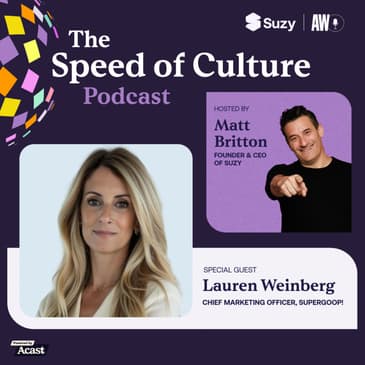
Live from the POSSIBLE conference in South Beach, Matt Britton welcomes Lauren Weinberg, Chief Marketing Officer at Supergoop!, to discuss her transition from tech giants like Square and Peloton to the beauty world. Lauren shares her approach to brand building in the sun care category and the importance of owning the product road map to drive strategic growth. She also talks about her deep dive into AI and why human intuition remains the anchor for authentic storytelling in an era of rapid digital change.
Follow Suzy on Twitter: @AskSuzyBiz
Follow Lauren Weinberg on LinkedIn
Subscribe to The Speed of Culture on your favorite podcast platform.
And if you have a question or suggestions for the show, send us an email at suzy@suzy.com
Hosted on Acast. See acast.com/privacy for more information.
[00:00:00] Everyone's talking about efficiency. And to me, that conversation is played out. And really, we should be talking about how people will discover brands in the future. It's not just an efficiency gain. That's actually just like the very like tip of the iceberg. And there's so many more interesting things.
[00:00:18] To thrive in a rapidly evolving landscape, brands must move at an ever increasing pace. I'm Matt Britton, founder and CEO of Suzy. Join me and key industry leaders as we dive deep into the shifting consumer trends within their industry, why it matters now, and how you can keep up. Welcome to the Speed of Culture.
[00:00:40] Up today on the Speed of Culture Podcast, we are live here at the POSSIBLE conference in South Beach. I'm thrilled to welcome my friend Lauren Weinberg, the Chief Marketing Officer at Supergoop. Lauren brings over 25 years of experience building and transforming brands across B2C and B2B with a deep expertise in blending data-driven strategy with powerful storytelling. Lauren, so great to see you today. So good to be here. Thanks so much for coming back. We don't have many multi-time guests here on the pod, but you're one of them. So consider yourself honored and obviously as well-deserved.
[00:01:09] I do. Thank you so much. Yeah. So you just very recently joined Supergoop. What was it about the brand and the opportunity that made you believe this was the right next move in your career?
[00:01:18] So I've been a Supergoop user for probably 10 years. I discovered Supergoop in Aspen and have loved the brand ever since. I love to dive into just new industries and places that I've never worked in before. And so I met the CEO, Mellis. We were in a board training program together and she called me and told me about that she was going to Supergoop to be the CEO and just all of the goals and aspirations that she had for really growing and scaling the brand.
[00:01:48] So I think that coupled with just my own love of the brand felt like a really great, fun thing, something I've never done before, opportunity to jump into. And for those in the audience that don't know what Supergoop is, would love to hear about it. Supergoop is a sun care brand. We've been around for 20 years, which is crazy. I think a lot of people don't realize that, but they're really known for a few really iconic products. One is the unseen sunscreen. It's a completely invisible sunscreen that just like rubs into every skin.
[00:02:17] You don't have like the all good white mark. No white cast. It's not sticky. It's not greasy. It has no odor to it. And it's just something that completely revolutionized the SPF category. And they're really known for products that are sunscreen that are just incredible skin care products, really high quality ingredients that people will want to use every day. And the goal is to get people to use sunscreen every single day. It's the most important thing you can do for your skin's health.
[00:02:43] Absolutely. And when you look at the brand, what's the channel strategy? Are you going direct to consumer? Is there a big retail footprint that you have? It's both. So we have direct to consumer and we have a retail footprint. We just recently expanded into Target. I would say historically, we were really more of a beauty brand in Sephora and Ulta. So in February, at the end of February, actually, we launched to Target. So still really new for us. And I think there's also some opportunity for us to scale on TikTok shop.
[00:03:10] We have some really fun product SKUs that are great for TikTok shop. So lots of opportunities for us to grow across really all of our distribution channels. And of course, somebody with your background comes to a brand like this and immediately sees opportunities and areas to go into. What is the onboarding process like for a CMO role? And what are you looking to get out of that? How long does it take? And at what point do you get to a place where you have confidence in conviction and say, OK, I'm ready?
[00:03:37] Well, I would say it's usually really insane. And that period is much shorter than you would want it to be. And so I think as a CMO, you get there and pretty much the expectation is like almost immediately that you are. The honeymoon phase is over. It's over. And it's really about making decisions and especially coming into Supergoop. I got there. We're launching in Target within a matter of weeks. We announced a PGA sponsorship. We were launching campaigns. Our high season is from April through August.
[00:04:05] And so you combine all those things. I also already had my first board meeting. And so it was a really intense onboarding period. I personally like that. I think just throw me into the deep end is the best way to really learn the business. It feels a little intense in the moment, but I think it's just a good way to really kind of understand all the facets of the business. And one thing that's new for me in this role is that I also am responsible for product innovation.
[00:04:31] And so it's been really fun, but a lot to learn there. I think for me, that's the area where I just like really have to understand how that process works, how long it takes, how do we develop formulas as a brand? What kind of testing do we need to do? Also, you have to flex, right? Yeah. And so it's been fun to learn that. I did have, as I mentioned, my first board meeting, which was six weeks into my time in the role where we had to present marketing strategy and a three-year product roadmap.
[00:04:59] Wow. I mean, what I like about the product innovation add-on for you is if you think about the best products that have taken off the fastest, it's normally not because they had great advertising. It's because they had a great product. And I think a lot of the best products are building marketing into the product, whether it's features, benefits, language you use, the packaging. There's so much you can do on the product that will then enable you to market through consumers versus to them, i.e. word of mouth.
[00:05:26] So I would imagine with your deep marketing experience, I think it's going to be intuitive to you to unlock opportunities within the product piece to make your job as a marketer much easier. Yes. I think when I spoke to a lot of people about moving into this world, since I really have been in mostly tech. I know. We'll get into that. Yeah. Yeah. Categories. A lot of people said, if you're going to go and do this, make sure that you own the product roadmap because it can be very challenging to be a marketer where you don't have some agency over the product strategy.
[00:05:55] And also for me, I wanted to do something that I've never done before. So it is really fun. And I think it's been so far a really great partnership with our chief innovation officer on where do we go? Right. What does the future look like for us? What are the places that what are the white space opportunities and where do we also either have the right to win or where can we earn the right? Right. It's far more of a strategic, even entrepreneurial type discussion than how are we going to deploy this marketing budget? Yeah. It's been fun. Yeah, I'm sure.
[00:06:23] So how much time are you spending in the early days of your journey there really trying to understand the consumer? Now, you have been a consumer, it sounds like. Yeah. Obviously makes it a lot easier. But are you going into more deep immersions to understand the competitive landscape and what are the benefits that consumers are gravitating towards? Yes. I want to know more about the consumers. I think I walked in and there's a pretty decent high level understanding. I feel like that's never like enough to scratch my itch. I always want to go a little bit deeper.
[00:06:52] So in a lot of ways, I am the consumer. So that makes it a little bit easier. But I think that we have opportunity to go even deeper. And what's interesting about our brand is that it's for everybody. Right. There's a lot of very young girls. The sun shines of all of us. Super fans of the brand. And all their moms tell me that my daughter won't go to Sephora without buying something from Supergoop. But we're also now at the PGA and my dad uses Supergoop. And so we have this really broad audience.
[00:07:20] So I think for us honing in on the target audience that we need to stay focused on as a brand is something that we have our eyes on who that is. And I'm kind of eager to dig in and learn more about those people over time. And as you learn about them, obviously, a key part of paying that off is then to be able to reach them. And as you know, and anyone, especially given your background in places like Square and Peloton is that content rules the day. Yeah. Right.
[00:07:47] So predating you, how has Supergoop been able to build its brand? And what are some of the new ways that you hope to impart on the brand strategy in terms of building awareness and engagement? Yeah. So I would say Supergoop is a brand that really was built on this idea of being relevant in culture. And it really was a change the category in a lot of ways because our whole mission is to get people to use sunscreen every single day. And it's really important for people to do that.
[00:08:13] And part of that is coming up with products that people will actually want to use as they kind of debunk all the myths or the things that people dislike about wearing sunscreen. Which is like white smears on your face. Yeah. All the things. Burning your eyes. Burning your eyes. Sticky white cast. Doesn't rub in with skin tones. Causing breakouts. Doesn't go with your makeup. Like, you name it. We've figured out a way to solve for all of those things. So that was basically the brand's mission. And they did that by showing up in moments of culture.
[00:08:41] I think over time they've gotten away from that and we want to bring it back. I think it's very important for us also to think about just the role that creators play. And so I think for the first time when we're planning campaigns, we're really thinking about the role that creators play in every single day. You have to. And how much money we want to spend against our message versus the creator message. Because there's a lot of education that still goes into our category in particular. We have a lot of different products.
[00:09:08] And I think creators can help people navigate our assortment better. When we talk about creators and influencers, we're talking about everybody from like beauty and lifestyle voices to chemist to dermatologist. You name it. And so really getting a myriad of different type of voices to compliment the storytelling that we do. And then also just showing up in culturally relevant moments. Like at the PGA Tour, we have an Altera Mountain sponsorship that we do as well.
[00:09:36] And so if you think about any place where people are outside for long periods of time in the sun, we could show up there as a brand. And we're trying to be really... Have a right to play there. Yeah, we have a right to play there. We want to be thoughtful and intentional. And I think the skiing and golf is a nice bookend because it keeps us in the conversation all year round. And so we really like it for that reason. I mean, this year, the average age of a first-time mom in the U.S. for the first time is Gen Z. So if you think about that, she grew up in the TikTok era, right?
[00:10:05] So she is not tuning in to linear media at all. Kids who are going to college right now do not have TVs in their dorm rooms. So it still amazes me that so many CPG companies look at creators like after they've planned their traditional media. Yeah. Because the reality is that is not in line with the new consumer who's over time becoming the consumer. Yeah. It's not just like this edge O young Gen Z kids. These are moms. I'm always buying stuff on TikTok shop. Right. So I get it. Right, totally.
[00:10:34] And in that regard, when you talk about TikTok shop, live shopping and some of the more emerging areas, what are some areas that you have your eye on? I mean, I feel like all of those places can be really relevant for us. It's really a matter of us thinking through the strategy and which products we want to market on those channels versus where we feel like a more traditional distribution channel like a Target or an Ulta or Sephora is better for us.
[00:10:58] And so for some reason, there are certain SKUs that we have that just do so well in that social selling type of environment. And so I think there's more. I mean, I've been in the role for not even three months. Right. Right. Doesn't seem like it. I still have a lot to learn about how do we think through that and what are the right bundles and ways that we can really just get more people into the brand. We have very high retention.
[00:11:22] And I think it feels like a lot of people know us and love us, but the reality is that our awareness is still pretty low. And so we have a lot of work to do to just introduce more people to the brand to help them understand why it's going to be a different experience for them and also why they should be thinking about their sunscreen every day.
[00:12:09] Yeah, for sure. And so I think part of it was just a lot of work to do. And I think part of it for me was just I always like the idea of doing something that I've never done before. And so that was this was exciting to me for that reason. The beauty industry is really fascinating. I would say as someone who's always been an end consumer of beauty products, I've never been in beauty. Right. And it can be very hard to get into beauty. And I thought I just want to be in. I want to be in this space.
[00:12:39] I've been in tech or tech adjacent businesses my entire career. If I want to go back to that, I feel like I always can. Right. And I was just ready for something different and to do something that was new. And then I think there was other just I only have a few years left with my kids at home. Yeah. And I wanted a company that's headquartered in New York. Right. And so when I was looking, there was a lot of opportunities on the West Coast. And I had been there, done that.
[00:13:02] And I feel like I just didn't want to spend really any time traveling or a lot of time away from home when I have so few years left with my kids at home. Yeah. I'm sure that's a decision you will not regret. What are some of the learnings you had from the tech sector and some of your prior roles that you think are really going to be applicable in your current role? So I think tech is really good at just this idea of an experimentation mindset. Right. Just constant testing and learning, which is not something I think.
[00:13:30] I think iteration and this idea of just like moving fast, but learning and having data behind decision making. And our CEO at Supergoop comes from Amazon. And so I think the two of us together really want to bring that kind of mindset into the brand, which is, if you don't know, test. Yeah. Test, get data back, continue to iterate and evolve. And that just to be a little bit scrappier and agile with an experimentation mindset, because the world, as we all know, has never been changing faster. Totally.
[00:13:58] And so we have so much to figure out. And you can't wait too long to make perfect decisions. And so I think tech does a beautiful job at that. And it's built into the DNA, I would say, of Silicon Valley in a lot of ways that I think brands like Supergoop can really benefit from bringing that type of thinking into their organization. And it's definitely tech has been more of a bottom funnel performance-based mindset where CPG companies and beauty have been much more about brand. Yeah. And storytelling.
[00:14:25] And I think, to me, you obviously need the marriage of both in order for it to work. Yes. Yes, agree. We'll be right back with The Speed of Culture after a few words from our sponsors. So I follow you on LinkedIn. I know that you went through a period where you weren't working. You took like a little bit of a hiatus. One thing I really admired was your transparency and how authentic you were about telling your story of figuring out what was next for you. Yeah.
[00:14:49] And we'd just love to hear, because a lot of people are going to be faced, already are, and unfortunately I believe will be continued to face with, just disruptions in their career based upon AI, based upon layoffs. Your former company famously cut 40% of its staff. Yeah. Right. Let's square. And it's going to happen over and over again. And many people will find themselves in a position where they have to reinvent themselves. And I would just love to hear a little bit about your journey, how you spent that time, and why do you think it was beneficial for you to take a little bit of a break? Yeah.
[00:15:17] I mean, I think it was the best thing. It was really great for me. It's something that I think I didn't realize I needed. Right. And I felt really good about how I spent my time, so I'm happy to talk about that more. But I went into that time off with an agenda of things that I wanted to do, and some of them were personal things. Mm-hmm. A lot of it for me, I felt, I talked to a lot of people that I've just mentors, people that I trust, and they said, just spend as much time as you can with AI.
[00:15:44] And I felt like as an operator at Peloton, it was so busy. And yes, we were integrating AI into our work streams. I did not feel that I had a really good understanding of truly how LLMs work. Most don't. What it means for brands. And so I felt really lucky to just have this period where I could learn. And I took a lot of courses. I was in an AI study group. We met every week with this group of people. Someone on LinkedIn said, I'm starting this group. Who wants in? Someone I haven't spoken to in 20 years.
[00:16:13] I said, I want in. I did a lot of other courses. And then I just played around with all of the tools. And then people asked me to talk about what I was seeing and what I was learning. And so that was really incredible because you don't get that kind of time when you're in a full time. You react to what's in front of you. Yeah. And so that gave me a chance to just form my own point of view about AI. But outside of that, I also just wanted to start doing more hobbies. And so I had a whole list of things.
[00:16:41] And I feel like I did almost everything that I wanted to do. Like I took up new sports. What's your favorite new sport you took up? Pickleball for sure. And I just was trying to catch up to my friends who are amazing pickleball players. And I was having anxiety about going to pickleball birthday parties because they were so good. So I feel like my goal was when I go back to work to be able to hold my own at a pickleball birthday party. So that's been really fun. I planted a vegetable garden.
[00:17:09] I just did a lot of stuff that I normally wouldn't be able to do. I was senior in high school. I got to be the soccer team mom, something I've never done in my career. I got very involved with different nonprofits. So Project Healthy Minds is one I spent a lot of time with. I also got very involved in Birthright with Israel. And so I really, as my kids would say, I was the busiest non-working person that they know. That's not surprising.
[00:17:35] And I also spent a lot of time talking to founders and CEOs and doing advisory work. And that is probably my favorite part of just getting enough time that when random people reach out to you on LinkedIn, that you can actually say, yeah, I'd love to have a conversation with you. I love hearing what people are building and what they're doing and if I can be a part of their journey in any way. So it was really fulfilling in a lot of ways. I was happy to go back and sad to go back. Yeah. And I think there's a lot of takeaways from that.
[00:18:03] But one is don't wait until you're not employed to have that network, to tap into mentors, to join courses, to do things. Because then you already kind of have a rolling head start and you really want to take control of your own destiny, right? Yes. I think that's a good point. I felt very fortunate to just have so many people because I was thinking about some things. And one of my really good friends said to me, don't do any consulting. Take the time and learn AI. It will just make you so much more valuable when you go back to work.
[00:18:33] And, you know, I think when someone you really trust tells you that, I thought, you know what, you're right. I should do that. And to make it your job to actually learn something every day is something that I think when you're really busy, you can always put it off to the side. So I'm really grateful that I have that time. So now that you've been through that and you've enriched yourself with all this knowledge in AI, what are some of the things you think you know that you see many other people don't really know yet about AI and capabilities really transform work, especially as a CMO or marketing?
[00:19:01] I think it keeps changing so rapidly, to be honest. But my first thought when I first started doing this, again, that was eight months ago, right? Or maybe actually more than that now. Which was ages ago in AI. Yes. Right? And my first thought was everyone's talking about efficiency. And to me, that conversation has played out. And really, we should be talking about how people will discover brands in the future. And now brands are having that conversation.
[00:19:27] But I wrote an article for Adweek early in my time off saying, why is nobody talking about this yet? Right. Around how consumers will discover brands and what are the things that brands need to be doing. To drive growth versus just cut costs. Yes. Because I think it's not just an efficiency gain. That's actually just like the very tip of the iceberg. And there's so many more interesting things. And it actually made me feel really excited about AI because as a storyteller and somebody that comes from that background and loves brands,
[00:19:56] it's an amazing time for brands because you have to be doing that stuff authentically, organically, showing up in credible places like third-party publications. That's what the LLMs are picking up. And so I think it's a fun time to be in marketing because you have to have a really clear point of view as a brand and know what your tone of voice is. And I think that's a more fun place to be than the previous decade where we're really focused primarily on performance marketing. Yeah.
[00:20:24] How do you feel as a marketer about AI-generated content? Do you think that's going to be taking off and that consumers will widely accept content that's created by AI? I think there's a place for it. But I don't think, like for my point of view, I don't think that it can only be AI-generated content. And I have some very strong points of views about things that I really believe need to at least start from a human, which the brief to me. Yeah.
[00:20:49] And I know a lot of people will use AI to write the brief, and it's one rule I have for my team is that like the first, use AI to improve it. But the first version needs to come from you. Has to come from a human, be based on human insights, be based on something that's credible and differentiated and unique. And to me, I think there's a place for AI to help scale and create more velocity, but not to be the incubation of the idea for the company. Yeah. It's interesting.
[00:21:18] My company, Susie, as you know, operates in the market research space. And one of the big trends a lot of people are talking about right now is synthetic panels. Yeah. Instead of asking real humans questions, who let's be honest, don't like filling out surveys, so there needs to be a different way. But the way that some companies are approaching it is we're going to basically simulate the way humans respond with AI agents.
[00:21:41] And it reminds me of what you're saying because AI agents have never fallen in love or broken their leg or got a promotion or had their heart broken or all these things. And it's in that human emotion where insights, I think, are born. Yeah. And I don't know if the AI agents would be able to really replicate that. Yeah. So I think there's always a place for it. It's just figuring out where it is. And I think for leaders to have a point of view, I've said to my team, never have AI right. Right.
[00:22:06] Because I just don't think you'll ever get to an idea that really like is rooted in consumer insights or even in our brand DNA that comes from it. Yeah. And you want to break through. And if AI is trained on AI, trained on AI, you're going to start to look like everyone else. And I think younger, like my kids in particular, I think are just like their discernment and ability to say like that's definitely AI. Right. I mean, I think like they know and sometimes people, but they know. Right. And so like they're excellent at spotting it. And sometimes they don't care.
[00:22:36] And so maybe some of it's okay. But I do think that's interesting too. It's just they can spot it immediately. Yeah. I mean, it's interesting because people, kids watch animated movies and those aren't real actors. People listen to electronic dance music and that's music that's not being my real instruments. Like if you actually start to look at a lot of the areas, it's not, and people eat a lot of synthetic flavoring in their food and, you know, processed stuff.
[00:23:00] So it's not like natural is the way that, especially in America, we're heading towards, we actually have been heading towards consuming synthetic stuff for a very long time. Yeah. So to me, we're going to continue to go in that direction until one day we wake up and we are going to be seeing so much AI content. But I think there's going to be a premium place on the human insight, on human generated content. Yeah. I mean, it's fascinating times. And as you said earlier, like things have never changed so fast. Yeah. And it's just so hard to keep up.
[00:23:28] But what are some of the things besides, I love your point about creating briefs, what are some of the things that you think stay the same, more so when it comes to attributes of somebody who's successful in a role like yours? I mean, I think that AI is an amazing tool for me, right? I'd be lying if I said it didn't like help make me more efficient. Yeah. But I also always write the first version of everything that I write, right? And it has to- You like to write? I do like to write.
[00:23:55] And I just think it has to come from me and be my point of view. And it clouds my judgment and my thinking if I take the shortcut and go AI first. And so I think for me, like I send, I try, it's been a little hard in this new role to send a weekly newsletter and I write it. And everyone said, why don't you just have AI write it? And I said, because it's my opportunity to connect with my team for them to see me on a human level. And so I can put it into Claude after I use it and it can make it better. Right.
[00:24:25] But it still has to always come from me. Well, it's almost like also going through the thinking process of what I'm going to write about. Yeah. Essentially also as you go through the thinking process of like what's most important, what do I need to focus? There's other things that come out of the writing process that aren't just the writing. Yes. Which you lose if you don't do the writing. Yes. And I think just as leaders and brands, people are craving connection and being together.
[00:24:48] And so I do think that that's fun and interesting to think about too, especially for a brand like Supergoop could show up in any moment in culture where people are exposed to the sun. And what role do we play in just getting people to put their device down and encouraging them to just connect with each other? Yeah. Go to the beach. Go ski. Touch grass. And do all those things.
[00:25:10] And so I think there's just a big role that we can play in finding opportunities to create moments that bring people together or just showing up in those moments and giving people product samples so that they can enjoy themselves and not have to worry about getting sunburned. Yeah. I read that Bruno Mars, his concert tour, he doesn't want you to put your phone in a bag. Like, I think you're going to start to see a big gravitational pull towards in real life. Yeah.
[00:25:34] I think people are really craving those, like that, like human connection and a chance to really disconnect from technology. Right. Now more than ever. Yeah. So you mentioned a bunch of times, which I admire during this conversation, your team. And obviously, great, this is an agency of others. And I know that you really pride yourself on your ability to be a leader. And you talked about the newsletter you're sending to your team. What do you look for in a team member?
[00:25:57] And what are the attributes when you're either during the interview process, when you first start working with someone that makes you know, okay, this person is the right type of person that I want to be working and building a business with? I have a couple things. I would say one is I really want people who are curious. Yeah. Who are just going to ask questions and not be scared to challenge me. Right. But I think curiosity, number one, my least favorite answer anyone can ever give me is we've always done it this way. Right.
[00:26:23] Especially for some brands that I worked at where they weren't even a decade old when I joined and people are saying, well, we've always done it this way. And so I absolutely hate that answer. I think also just having a lot of conviction, marketing is so interesting because everybody thinks that they can do it. And so everyone has an opinion about what you should be doing. Creative feedback is very subjective. And so I'm looking for people that have conviction, conviction in their ideas. It's always going to be my job to pressure test their ideas a little bit.
[00:26:52] And I like people that have that conviction to kind of come back and really say, I don't think you're thinking about it in the right way. Get behind. Yeah, like get behind it. I'm going to say what I don't like about it. And it's your job to prove me wrong. I like that. And I always tell people that's how I want to work. I don't know everything. I want you to challenge me. So I also need people who are like courageous, who are not going to be scared to say to the boss, hey, I think you're not thinking about this in the right way. And I'll always say, yeah, tell me more. Say why.
[00:27:22] And sometimes they're right and sometimes they're not right. But either way, I appreciate that and do not want to surround myself with people that are going to say yes to me. And so. Well, that's what AI can do. AI can say yes to you. Exactly. If you want people to follow orders deterministically, that's exactly. Yeah. AI is great at being sycophantic. That's great. Right. So I want people that are going to say you're wrong. I think you missed something. And so that's how I like to work.
[00:27:47] And it's my job to create enough psychological safety on the team for people to feel that they can work with me in that way. It takes time. But I think usually we get there. Yeah. I mean, it's two sides of the same coin in terms of not being afraid to challenge you and to have conviction. Both of them need to create an environment, to your point, where they feel like they can do so without fear of repercussion. Yeah. And they're not just in a world where a while ago we had this campaign, Hippo, the highest paid person's opinion. Yeah. Right? And so many companies operate with the Hippo.
[00:28:17] Like no one has a point of view. They're all looking towards the end of the day. Yeah. And I think companies like that in a world where there's so many different points of views, you're trying to really understand the consumer. That's not a path to success. I mean, especially for me in this role, I need people that I don't come from beauty. So I'm going to hire people that come from beauty in some roles and I want them to tell me the things that I don't know. I mean, I try to hire people that are smarter and better than me in specific areas so that we can complement each other. Absolutely.
[00:28:45] So to wrap up here, and I knew this would be a great chat and so thankful that we got you right on the heels of this new role. When you look back at your journey and all the places you've been, what are some of the areas that you think you leaned into fortuitously in a rearview mirror that put you in a position of the CMO role today? Because so many people come into the workforce and the advertising industry and want to be a CMO. You are one. You're a second time guest on this podcast. You're obviously doing something right, right?
[00:29:12] What are some of the things that you think you did right along the way? I'll start by saying that I didn't know I wanted to be a CMO. And so I think that always surprises people, but I didn't start off on a specific journey. And so for me, I like to describe my career as like a happy accident. And so it genuinely was something that I was interested in doing next where I would raise my hand and say, can I try that? Can I do that next? And I just did that all throughout my career.
[00:29:41] I also started working in 2000. And so that was a really crazy time. Beginning of the dot-com boom. Yeah. And then the bust. And so I think during the bust, I remember saying to my boss at the time, I don't feel like I can do this job that you want me to do. And he said, sink or swim, because there's literally a million people that would take your job tomorrow. Right.
[00:30:03] And so I started off working in this idea of being comfortable, being really uncomfortable, which I'm so grateful for. Looking back, I think that gave me the mindset of when I feel comfortable, I'm ready for something else. And so whenever I take a new role, I always try to have it grounded in something that I believe I can be successful in and something I've never done before. Right. And then you continue to just like gain skill sets along the way.
[00:30:29] And then at one point at Yahoo, somebody said to me, you'd be a really good CMO one day. And I said, I've never really thought about being a CMO. Why do you think they said that? I think at the time I was running almost all of marketing at Yahoo. You're an activist one, bro. And also because I think my point of view is come to the table when you're invited and bring value and you'll get invited back. That's always my career advice for people, young people. They hate that, but it's the truth. Do a good job in the job you have.
[00:30:57] And when you get invited to the table, bring value so that people want to bring you back again. And so I did that. That's what I tried to do all throughout my career. And I think that gave me the permission when I raised my hand and said, I know I've never done that before, but can I try it? And if it doesn't work, I'm still happy in the job that I have. And so I just started to like accumulate skills over time. And I was at Yahoo for six years.
[00:31:23] And during that time, I went from B2B to consumer and started taking over media buying and planning. And then there was all these things that I realized that I really loved that I'd never done before. And so when I went to Square, I wasn't the CMO initially, but I went there and I said, I really want to run marketing one day. And the thing that I need to learn the most about is creative. And so that wasn't in my team, but I said, I want to shadow all of the creative feedback sessions for a year.
[00:31:52] And at the end of the year, the head of creative said, I would like to report to you now. And so I think like for me, I've always just thought, what do I need to learn? What's next? And not always with a quid pro quo, like I'm going to learn this. Was it, do I get a promotion or something? No, I just thought this is the area that I've spent the least amount of time in and I don't feel that comfortable always giving feedback. And I just want to be a fly on the wall to see the process unfold for a long period of time. No agenda other than I'm here to learn.
[00:32:22] And over time, then they would always say, what do you think? What's your opinion? And I think for me, that was a really great way to get into it. But I went there and said, this is the thing that I want to spend more time getting to know. And I think if you can be intentional about the skills that you want to get and what you want to go do, your organization, especially in large companies like Square and Yahoo, make it really easy for you to go and do that. It was like just shadow. Yeah, for sure. I think it's great advice.
[00:32:50] And I think too many people, I think the whole Instagram generation of seeing everybody kill it and it takes away people's patience and it makes them just want to get to what's next so fast and not go through the proper development that you need to get there. And I think it makes people make short term decisions, whether it's like, oh, it's a better title. Oh, it's a better role. Yeah. It doesn't matter if I'm taking a step back and how I'm going to develop myself.
[00:33:15] And I think that may work in the short term, but long term, you're probably going to be unhappy with where you ended up. I also think being a CMO is a very hard job. So sometimes people come to me and say, I want to be a CMO. And I'll say, do you know what I even do? Right. In a day. Right. Because I actually don't know if you really even do. And so it's not just going to Cannes and having Rose and right. Right. I know my kids are like, I want to go into marketing. Why? You get tickets. Right. Exactly. Like, right. The least like important thing.
[00:33:42] Sometimes you get tickets and you have to sit next to people who you don't really want to sit next to either. Yeah. But there's a lot of other really hard things that go into it. And it's a really hard job. I mean, I love it. And I think that it lets you use your left and your right brain and all those things. But you're constantly on and getting cold. Dealing with people. Dealing with people. Right. Relationships. You're at the center of almost everything that happens in an organization. And a lot of times you're responsible for growth. So there's a lot of pressure on CMOs. Yeah. It's definitely not for everybody. Yeah. Awesome.
[00:34:12] Well, this has been a great chat. Our last question that we ask our guests always, if there's a saying or mantra, you probably don't remember the one that you gave us a couple years ago. So if you repeat it again, we'll forgive you. I don't remember. Given all your personal growth and everything that's happened since then, I imagine it'd be something new. So. I think right now for me, it's to have fun.
[00:34:31] And for Supergoop, which is this brand that has just this such this like joyful personality that if you're not having fun at work, I don't think that people feel that sense of joy from your brand. And Peloton and Supergoop are two brands that I think just bring a lot of like joy and happiness to people's life. And so my mantra is have fun. And yes, there's serious work that has to be done. But I want the end consumers to feel the joy and the fun that goes into making the work.
[00:35:00] And I think you actually have to be having fun for them to feel that. Well, this podcast was a lot of fun, too. Thank you. Thank you for that. But thank you so much for taking time out of your busy schedule here at the conference to tell your story. So good to be here again. I feel honored to get a second invite. Absolutely. You definitely deliver. So we'll have you back again. On behalf of the United Way team, thanks again to my friend Lauren Weinberg, Chief Marketing Officer of Supergoop, for joining us today. Be sure to subscribe, rate, and review the Speed of Culture podcast on your favorite podcast platform. We're here in South Beach.
[00:35:30] We'll see you soon. Bye-bye. The Speed of Culture is brought to you by Suzy as part of the Adweek Podcast Network and Agast Creator Network. You can listen and subscribe to all Adweek's podcasts by visiting adweek.com slash podcasts. To find out more about Suzy, head to suzy.com. And make sure to search for the Speed of Culture in Apple Podcasts, Spotify, or anywhere else podcasts are found. Click follow so you don't miss out on any future episodes.
[00:35:59] On behalf of the team here at Suzy, thanks for listening. Cruirs knewen to see you atenebrosis. This episode began to use on many смыс 있어서 simplemente ASP Fullmote and AgastsismaCu toании on direct or any future episodes.