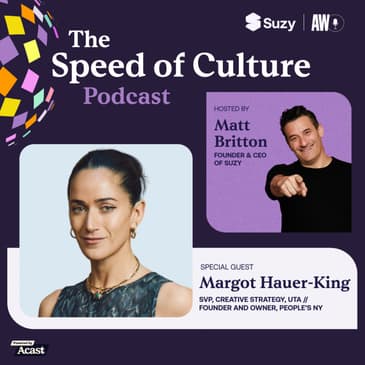
In this episode of The Speed of Culture podcast, Margot Hauer-King, SVP Creative Strategy at United Talent Agency and Founder and Owner of People’s, joins Matt Britton live from the POSSIBLE conference in South Beach. Margot shares how UTA's deep roots in talent and entertainment give brands a unique advantage in building authentic cultural relevance. The conversation covers the tension between monoculture and micro-community, how brands can earn the right to participate in fast-moving trends, and why the best marketing often looks more like hosting a great dinner party than running a campaign. Margot also opens up about her parallel life as a bar owner in New York, the power of persuasive storytelling, and why leaving people happier than you found them is the career advice that has guided her most.
Follow Suzy on Twitter: @AskSuzyBiz
Follow Margot Hauer-King on LinkedIn
Subscribe to The Speed of Culture on your favorite podcast platform.
And if you have a question or suggestions for the show, send us an email at suzy@suzy.com
Hosted on Acast. See acast.com/privacy for more information.
[00:00:00] When you see ice hockey players sitting on the side, they don't have their feet out of their boots reading a book. You might be on the side, but you're ready. They jump into that ice so quick. Brands need to be that. They need to have all of that homework, all of that self-discovery. Who am I? What is my compass? Where and how do I fit into culture so that they can react in those moments?
[00:00:24] To thrive in a rapidly evolving landscape, brands must move at an ever-increasing pace. I'm Matt Britton, founder and CEO of Suzy. Join me and key industry leaders as we dive deep into the shifting consumer trends within their industry, why it matters now, and how you can keep up. Welcome to the Speed of Culture.
[00:00:46] Up to the end of the Speed of Culture Podcast, we're thrilled to welcome Margo Howard-King, the SVP of Creative Strategy at United Talent Agency, otherwise known as UTA, and founder and owner of Peoples. Margo sits at the intersection of culture, entertainment, and brand strategy, helping companies understand not just what's happening now, but what's coming next. Margo, so great to see you. Nice to see you too. So what brings you down to sunny South Beach for the possible conference? Sunshine. Okay.
[00:01:10] We've had a brutal, brutal winter in New York. No, it's UTA. We had an event last night, and I joined about six months ago. Okay. We've had a great conveners, whether it's talent, creator, brands, and so these are fun moments to see everyone. So tell me about your background and the road that led to you eventually ending up. It's a weird winding road.
[00:01:37] I will try not to give you my whole life history, but I grew up in a family of storytellers. My mom was in theater. She had a documentary film company, and my dad is in hospitality. And people don't necessarily think of hospitality as storytelling, but the guy was writing made-up stories and scripts about this restaurant, about old Viennese couples who moved to London. So I was always surrounded by this incredible love.
[00:02:04] You have a lot of memories of being exposed to that skill growing up. So much. And when you're growing up around that kind of energy, you don't really see it as anything but normal. And then you realize as you get old, you're like, wow, that's actually very different and very unique. And I graduated from college in the States, and I knew I wanted to do something that brought that storytelling to bear. But unlike the rest of my family who all were, you know, actor, director, restauranteur, I didn't know exactly what that thing was.
[00:02:33] And I landed at WPP. I thought that was an amazing place to tell stories, but do it in what felt like this other itch in me, which was a bit more commercial. Right. My family thinks I'm very corporate. They bought me a briefcase. Well, it's not cheap to live in New York, right? So sometimes you have to apply what you love to a business sense because you have to, you know, pay the rent, right? Totally. And I think it's really interesting, you know, that idea of, you know, what I've sort of learned to call persuasive storytelling.
[00:03:00] You know, art for art's sake, storytelling for the beauty of storytelling is amazing. But there's also something fascinating about stories in search of some kind of very specific outcome. And that's what we do when we're, you know, in this industry and building brands and communicating with audiences. So I ended up at WPP, spent quite a while there, moved to a couple of other businesses, big, small. And then I decided to open a bar. And it was one of those things I said I would never touch.
[00:03:30] I had no interest in going into hospitality. You think it was just your father's influence and you just kind of went to see if you could do it? He's six foot five, like big shoes to fill. So I was like, I don't want to do this. And then as I got older, I think it was a confluence of two things. I think partly it was realizing kind of to your point about growing up around that, realizing the stuff was kind of in my DNA. And then I actually felt it a lot more than I had in me a lot more than I realized and wanted some kind of outlet for that.
[00:03:57] It was partly the fact that, you know, having spent years working with brands and speaking to CMOs and helping them craft their story and their message to the world. I was like, I kind of have a message that I want to craft. And I felt that it would also help me kind of hone my abilities in that other part of my life because I can look a CMO in the eye and be like, I get it. Every dollar you spend is a big choice. And there was a sort of affinity point there. And then the third really blunt thing is I felt a need in New York.
[00:04:25] And it sounds ridiculous because New York has, I think, like highest restaurants and bars per capita. But something after COVID had shifted. And I was like, where do I want to go out? Like, where do I want to spend time? And there was such an insane surge of members clubs opening. And I just felt this need with my business partner to do something a bit different. Okay. So we opened People's about a year and a half ago. It's been more of a joy and more of a headache than you could ever have imagined. I've loved it. How often do you go there?
[00:04:55] I'm there most of the time. Really? Yeah. I'm there a lot. And I heard Dave Grutman on this podcast talking about the role in hospitality when you kind of shift into not drinking. I've never drunk as little since I opened a bar, but I've never been out more. Right. Which is an interesting shift to make. But I'm there a lot. And it's amazing because I'm a firm believer that you're only as good as the great people around you.
[00:05:20] And both UTA and People's are just such like abundance of riches in terms of meeting people. And on a really great day, I'm like meeting clients from there, there. And it all kind of just is perfect harmony. It also keeps you in the world that you want to be in for UTA, right? Because part of UTA is connecting brands with culture and celebrity and talent. And so much of that is on display at nightlife, right?
[00:05:47] In terms of what people wear, what they're talking about, who's coming in, what's popular. So I would imagine it's sort of like a living focus group, if you will. And it feeds your brain with ideas and you apply towards your work at UTA. Yeah, I love that way of putting it. And 100%, you know, I think I was so interested in what UTA, to take a quick step back, because you're bringing something really important up. I always knew UTA in the context of like an agency, like a talent agency.
[00:06:14] And when I realized that all this other amazing work was happening in the brand space, I was like, oh, that's fascinating. Because everyone is running to participate in what is this new need to build cultural competency within brands. And content creation. And this is a business that is in no way having to catch up. Like that's just what this business has always been. The world's going to where this business is. Yeah.
[00:06:41] We're just applying what is an authentic, integrated part of who we are, culture, into how we converse and support brands. So, you know, I think that that was so incredibly appealing to me. And it made the peoples of it all work. Because I can say to the business, like UTA is in the business of culture. And that's what peoples is too. It's the same thing. So people will often ask me like, which hat are you wearing right now?
[00:07:09] And I'm like, I'm kind of just wearing two hats. I think what people don't understand is because, you know, I run a software company. I do a lot of public speaking, consulting. And it's like, well, how do you do everything? And it's like, I don't know how to do one without the other. Because there's things I take away from one thing that I apply to another thing. And when you're an entrepreneur, when you are ambitious, you want to be involved in a lot of different things. And I think like one plus one can equal three. Especially if you're passionate about both things that you're doing. Completely.
[00:07:37] And I do think that, you know, there are some people who really, truly excel with single-minded focus. And my husband is one of them. Like that is how his brain absolutely sets on fire. And it's amazing. And there's a lot of benefits to that too. Tons. I'm a little bit envious of that. Oh, every day. But I think there's another type of brain. And I've, you know, it's taken me a minute, but I'm now not just accepting it, but embracing it. That to your point really thrives on that.
[00:08:05] And there's sort of reveal that I'm a total nerd. But there's a quote from a book that I love. And Margaret Atwood. And she says, where did we learn that talent for insatiability? And when I was young, I felt like my sort of insatiability, like my, was a problem. Because again, I was in this family that had very clear views of like, this is the thing. And I'm now finally seeing how joyful it can be and how much it tickles my personal brain to be doing all these different things and let them work in concert.
[00:08:35] Yeah. So you joined UTA. So tell me about, you've been there for six months, you said. So what was one thing that surprised you about the company and the culture? The amount of information and knowledge that sits in this business. I mean, I feel there's a lot of conversation at the moment about obviously AI, but then simultaneously like intuition and just knowing. And that kind of, you know it when you see it thing. And it's amazing to walk into a business where you really see both working together.
[00:09:03] We have so much rigor around how we are understanding what's going on. And I mean that not only in the brand space, but in the creative space. And like what films are coming, like we just know everything. There's also this much more intangible thing that just happens of having all these different people doing all these different things. But ultimately towards the same end goal. Interacting. To give you a really kind of weird answer. One of the things that surprised me is we still have phone culture. UTA. I felt a little bit.
[00:09:33] Phone culture meaning you call each other. The phone and call each other. It's not just meeting culture. Which I love. I have a friend. And it's one of my. Like unannounced. Like your phone will just ring and you pick it up. Call each other. It's kind of radical. What is this, 1986? I know. Right. And I have this friend and she's got this amazing line. She also works in hospitality. And she always says, emails are embarrassing. Don't get me started on Zoom. Right.
[00:09:56] And I think we've got to this funny place where like you go into your day and your day is a series of squares in your calendar. And you're meant to keep your conversations and your outcomes and your objectives and your to-dos in these little boxes. And I think it has an interesting. Very structured pre-planned. Those structures. So pre-planned. And age of world picks up the phone. People just call each other. Right. And I have found that so refreshing but also genuinely productive.
[00:10:22] I would say the other thing that I've been really taken by is people are interested in getting to know each other. And this is a business that was very small and is now very big. And I've been in very big businesses before. Huge businesses. And it's good to see that. You know, people will just proactively reach out. Oh, you sit in a completely different department, Margot. You work with brands. I don't understand what you do. Can we grab a coffee? And there's this kind of phone times coffee culture that I think, looping back to the beginning of my answer,
[00:10:52] is what feeds that less structured side of how we keep our finger on the pulse. Yeah. So tell me about your day-to-day role. What are you focused on? What does success look like for you at UTA? That's a great question. If I had to put it in quite simple terms, my focus right now is sort of equal parts between thinking about great work for brands. How do we put them at a cultural forefront? And my kind of obsession right now is this idea that we're all just screaming for attention.
[00:11:21] So, like, how do we not kind of chase where it's happening and really, truly create that with our brands? And then the other part is my big focus is telling the world what we're up to because, candidly, I didn't know. So storytelling to the business world what UTA does because people typecast them as a talent agency. Yeah, I had a friend say to me, are you an agent now? Well, United Talent Agency, it's in the name. It is, and it's in the DNA.
[00:11:48] And I think it's something that we need to celebrate and be proud of because it gives us such a depth of credibility. But it can also typecast you. But it can typecast. The talent agent, you were more than a talent agent. So that's a big part of my role and my focus right now is how do we demonstrate that to the world, like the breadth of what we're doing. And I lied. There's three parts. And the other part is, you know, I'm a middle child. And I've always joked that the roles I've been happiest in are where I professionalize my middle childhood.
[00:12:14] And so finding in a business, whether it's coffee and phone culture, how do you really lean into that for the objectives that we have? So how do I make sure that whether it's film, creator, sports, that I'm so in like everyone's business so that I can bring the best to bear for my clients and my colleagues can do the same for us. Gotcha. So let's unpack some of that. So you talk about helping brands understand their role and culture and having to tell a story in a world where everyone's clamoring for attention. What does that process look like?
[00:12:43] Like what do you need to know from a brand in order to come back with a solution on behalf of your firm that will help them move the needle? That's a great question. I'm going to use a dinner party example. Okay. So if you have a dinner party, people come over and your home looks the way your home looks and you are who you are and you can cook what you can cook. But if you're a good host, what do you do? You think about your guests. Right. I'm going to think, oh, do you have a diet. They have, right. Yeah.
[00:13:12] He likes, oh, I remember he likes white wine. Or who they sit next to. That is like watching a sort of symphony orchestra. Like the Larry David show. Like can you be a middler? You know what I'm talking about. Yeah. And what's the side sit thing? Exactly. Yeah. I love it. That's a great episode. Yeah. So a dinner party to me is a great dinner party is the fusion between who am I and what am I expressing through this act of hospitality? And who is my guest?
[00:13:41] And where is my empathy for that guest? And I think it's such a simple thing to lose sight of because it's such a natural thing that we do for each other. But often when brands want to truly participate in culture, it's the same matrix. So we want to spend time with our brand to understand really who are you as a brand? Like what does your plateware look like? What light setting feels right for your dinner party? And then who is that consumer and what are their dietaries and what are their preferences and who are they going to get on with?
[00:14:10] And when you can bring those two things together, you throw an amazing party, you build an amazing brand culture. And like I think where brands might have once upon a time, you know, I've seen it go in both ways. Either too much broadcast. This is who I am. This is who I am. Think of that as you come to my house and I show you a PowerPoint presentation about why you're going to love my dinner party. Very linear, top of funnel. Very transactional. Very like this is what I'm doing to you.
[00:14:35] And then the flip side, we've obviously seen brands who overly cater, overly empathize and actually lose sight of who they are. And suddenly I'm serving six different meals to six different people. You're everything to everyone. You're everything to everyone. And so I think the ability to interact in culture, i.e. be in places people want to be and show up in ways that they actually want to engage with versus sort of forcing them to engage with you. We need to figure out for them who is your guest. What do they care about? What's going to give them a good night?
[00:15:05] But who are you and how do you provide against that? What's your authentic way of providing?
[00:15:39] I hadn't even extended the analogy to that point because I think what you're raising is such an interesting phenomenon right now. I would say that you've got a lot of people over here saying that we've reached kind of peak monoculture. A lot of people over here saying that we've never seen more micro communities. Well, because of the long tail in media.
[00:16:00] Like it used to be, you know, I think there's some stat that like 99 out of the top 100 most listened songs of all time happened 1990 or earlier because now there's just a long tail. Right? So it's just everyone's listening to their own thing on Spotify and the same with YouTube and videos. So the long tail is there and that does create this rugged individualism. Yet the whole country watches a Super Bowl. Yes. I think it's partly that long tail of just there's so much more. Yeah.
[00:16:30] But also it's that coinciding with so many more ways to consume that more. So, for example, and I'm going to run with your music point here. When I was like an angsty 13 year old, like what did I do to find my community? I listened to Green Day. Right. I didn't have subreddits. I didn't have TikTok. Right. I didn't have a gaming friendship group. You know, I didn't have all these other places that I could actually find that community. So in some ways, I don't think the radical individualism is new.
[00:16:59] I think we're being given platforms and content to let it breathe and let it become more visible. And then, you know, I think on the flip side, on this point of monoculture, it's the same. As you say, it's the Super Bowl. It's the same thing. You know, I walk around New York, which when I was growing up, New York, everyone looked different. You can wear whatever you want. Like you're never going to be the most weirdly dressed person on the streets in New York. That's what I was always told.
[00:17:24] Whereas now you can often walk down the street and you will literally see hordes of people in the same outfit, the same sunglasses, the same drink in their hand. What do you think drives that? When you see women in Soho all dressed in the same style, is that driven by just a couple influencers on Instagram? Like, how do you think that happens? I asked a similar question to someone the other day, one of my colleagues. I was like, what is going? Because I walked in and I had just seen one of these sort of hordes. And I turned to my colleague. What was the horde wearing? Jeans and a white top. Right.
[00:17:54] I'm not wearing jeans and a white top. Thank God. And there's nothing wrong with jeans and a white top. Exactly. If your audience wearing jeans and a white top, we're good. Yeah. For a reason. Exactly. And my colleague, UTA Matt, turns to me, looks me dead in the eye, and he says carcinization. And I was like, what's carcinization? Never heard that either. Never heard this word. And he proceeds to tell me about this completely insane evolutionary phenomenon where, stay with me here, non-crab crustaceans evolve into crabs.
[00:18:24] And I'm looking at him like, it's 9 a.m. Why are you talking to me about crabs? But I couldn't get it out of my head the rest of the day. And I was like, that's fascinating. Like, this idea that there is this evolutionary gravity that pulls us towards this final same form. And why is that? And I think all the same reasons that we're discussing as drivers of individualism, I think are doing the same thing.
[00:18:53] It's the access to media. It's the scale of everything that happens. It's down to these really, like, pragmatic, not cool reasons that just the scale of what brands can produce these days. There's so much ability. Also, like, I think data-driven targeting where it's lookalike modeling, like this person just bought these jeans and a white t-shirt. We're going to actually find 10,000 people that have the same psychographic and demographic profile as this person.
[00:19:22] And we're going to hit them with this same thing. And it could be driven from corporations and just the ability to leverage big data in such a powerful way where the person is being sort of forced into these cohorts without them even knowing it. It might even be choiceful. Yeah. But I think when it becomes choiceful, you know, I think creators have proved that this is not a trend. This is part of just in all ways how we move through the world now. And I think you brought up the word community earlier.
[00:19:51] And I think people deeply crave belonging. Yeah. And what you wear and what you drink are deep ways of manifesting or quick ways, I should say, of manifesting belonging. We'll be right back with The Speed of Culture after a few words from our sponsors. I have a great example for you, which I'm curious to hear your take on. So Mahjong is exploding now, right? So I live in South Florida and my wife and all of her friends will play.
[00:20:20] And it used to be an old ladies game, like my mom's 77. She plays it. And now all these young women, young moms are playing Mahjong all the time and they're buying fancy tiles. And then now the influencers they follow, they probably maybe started first doing it. And now it's driving, you know, a whole new wave of things that people buy and how they spend their time. And pickleball is obviously another example of a much more mass market, if you will. But just curious, like a trend like Mahjong, right?
[00:20:50] Like, is that like a type of idea that you might bring to a client? And how do you think something like that gets started? It's a great question. I mean, the Mahjong thing is fascinating. We went from not even being in the same city, but let alone breath as a request for event at People's to I got like three Mahjong event requests. Really? Yeah, suddenly. And the other day I got a sponsored ad for... And now you're going to get a thousand of them. Yeah.
[00:21:15] And I don't know what this says about me, but it was a Mahjong app, like you can play on your phone for weight loss. And I was like, so now Mahjong... Right. It's like, oh, wow. Okay. So we're combining it with another thing. Great. Brilliant. Would we take that to... Yes. Right. If it makes sense for that. Of course. Right. And I think the culture is happening at like a million different planes all at once. I think that there are things that I would call evergreen trends, like just they're here and they're true.
[00:21:44] It's almost just like human truths. Right. Like that's just who we are. Yeah. And I would maybe put like wellness somewhere in there. Yeah. Then you have more, I would say like medium term things. Then you have things that feel really in the moment, like flash in the pan. Yeah. And I think, I don't know where Mahjong is going to sit. Right. You know, pickleball, which you brought up. Right. Well, now it's already... A lot of the people are now playing Paddel. Yeah. And the people who used to play pickleball and swear, they're like, oh no, I'm over it. Now I'm in Paddel. I'm doing Paddel. So you're like, all right.
[00:22:12] So is the flash in the pan, short-term trend, pickleball, but the long-term trend is accessible tennis? Right. And like that becomes a really interesting sort of fabric to pick through and it's our responsibility to our clients. But I also think, you know, I say frequently to the brands we work with, like don't do the flash of lightning approach to culture. Right. And what I mean when I say that is you can't just show up in people's lives in a completely different way out of the blue and expect them to buy it. Yeah.
[00:22:41] If you don't have a right to play there. Yeah. Right. We've seen it now. Right. This isn't new and we're all too cynical and we're all too like smart for our own good when it comes to advertising now. And we smell a rat. What I think is very nuanced and different there, that doesn't mean that if you're a brand that has established yourself as a participant in culture, that doesn't mean you can't play in what could be a lightning flash moment. So it's like when you're looking at this as a whole, build cultural muscle and capability.
[00:23:10] But if you feel like jumping in on a quick trend, go for it. You know, another one that came up recently that I thought was really interesting was quarter zips and matcha. And there was this suddenly overnight viral thing that young black men were posting on TikTok saying I'm in a quarter zip and I'm drinking a matcha. And it became this really interesting conversation about I'm leveling myself up. Right. Like, and it was a really self-aware. Or like redefining stereotypes. Yeah.
[00:23:37] It was super self-aware and it was really interesting. And it happened so quickly. And I think that there were some brands who have earned the right in credibility who could have participated in that conversation. Do I think in a year, in two years from now, people will be talking about quarter zips and matcha on TikTok? No, that community will move on. They'll have their next thing that's talking about. But you were there when it happened. The question, I guess, what is the underlying insight behind that?
[00:24:03] Because I think what you're getting at is when these things happen, what you see on TikTok is the manifestation of an underlying insight. Yes. And if the trend goes away, it doesn't mean the insight won't. And I think even going back to the pickle, Padel, it's like, you know, men want a way to play, or women do, to play with each other's sports in a way that maybe what doesn't have such a commitment that tennis has. Right. But they really wanted that community. They want that physical activity. More about a competitiveness. Yeah.
[00:24:33] But they don't want tennis. Right. Exactly. For whatever reason. Right. So now the question is, now we'll end up at tennis at the end? Maybe. Maybe it all goes back to tennis. Maybe. Who doesn't? Maybe it's great. Customization again. There you go. So it's interesting to see how that. Well, I think to that point, it's the dinner party again. And the ability to respond to a short-term trend is entirely predicated back on what we were saying that brands need to do to do this work well, which is know who they are.
[00:25:01] Because you don't know if that insight's for you if you haven't done that work. Yeah. You can't, out of left field, be like, oh, that feels like it could be interesting and on brand for us. Let's try. First of all, your internal structures are not going to be set up for it. And we've all seen too many ideas die on the vine of internal just ways of working. So you need to build that landscape and do that work, but you need to know who you are. Otherwise, you're never going to see that amazing thing fly past you and realize it's yours to jump on.
[00:25:31] Do you think the same dynamic exists with celebrity? So you mentioned a Dave Grutman podcast, and he's producing a reality show with Alex Earl. Alex Earl is the it girl right now, right? And she's done a great job building her own personal brand. And she was on Dancing with the Stars. Now she's having a reality show. Whether we're talking about her in 10 years from now remains to be seen. I mean, the Kardashians are still obviously. They've done an amazing job of getting staying power. Not everyone loves them, but you can't knock their hustle.
[00:26:00] Right, it's incredible the impact they've had on culture. When you think about connecting brands with celebrities, it used to be in the past, oh, we will give you Julia Roberts or Tom Cruise. Like these are A-listers. But now the traditional movie stars aren't necessarily moving the needle as much as the creators of the moment, the Alex Earls of the moment. So what is your take on how the framework we're talking about, about trends, applies the notion of celebrity and talent? The harsh answer is that some of them will stick around.
[00:26:29] Make it in others won't. And that is inevitable and natural. And for some people, that's actually what they want. When you brought up Alex, oh, I was going to mention the Kardashians because I think she's achieved a lot of what they achieved. And it's interesting to look at the comparisons and how. They started on TV, right? The Kardashians started on TV because there was not really social media when they started. They created, in some way, social media on TV. Well, Ryan Seacrest did. He did. He's actually the guy who really was behind a lot of it. Yeah.
[00:26:56] We see, you're seeing, if you want to like draw the line, like that's where I start. What we see now with creators is that form of like reality TV was social media. It was personal. We aren't building power social relationships with movie stars in the same way, unless they're also really active on social. Like that relationship that we're building with someone when they're not acting, when they're them, is very different. And it benefits immensely from frequency. It benefits from contacts. So, you know, Alex Earl brings in her family a lot.
[00:27:26] You get to know her. You're rooting for her. You get to know her and you're sort of in that story. I think we talk to brands about how to interact with celebrities or how to interact with creators. It's such an interesting conversation now because you're not looking at a one-stop shop of how this works. We had the period of famous person on billboards. And now we're in this era where, and again, I'll use Alex Al, she's taking equity in some
[00:27:55] of the businesses that she's then talking about. There is this much more involved relationship between brands and the people they surround themselves with. And they're also starting their own businesses sometimes. And they're starting their own businesses. I mean, again, if we're drawing lines like Bethany Frankel, like that, and those reality shows, I think are a really interesting thing to go back to. 100%. When you're looking at where we are now. All the way back to the real world and MTV, which is like, I think it was the first sign
[00:28:24] that people are ultimately more interesting than scripted characters. And then you had survivors and you had American Idol. Like it goes all the way through the trajectory of where we are today, where people are looking at other people's lives in a way it's more interesting. And if you ask people why they love Alex Al, a lot of them will say, because she was honest with us, she told us. And when she did this to her body, she told us. And that's why these parasocial relationships become so intense. And that was an interesting. By the way, I just want to say, I think it's all about relatability.
[00:28:53] I think like nobody loves that girl who's just flexing Cartier and Prada and Chanel like nonstop and pretend like life is good. They might follow you, but they all hate you. Right. But somebody who has been fortunate in life. Right. But still shows their warts, shows that they're vulnerable, shows that life isn't perfect. Yeah. Those are the people I think people root for and love. And I think so many people struggle with even on LinkedIn. It's like somebody who says, oh, I'm killing it. I'm killing no one.
[00:29:23] But if you say, oh, I made a mistake or I had to make a tough decision today. It's the same thing in business as well. And that's such a powerful approach for brands to say. Yes. You know, brands. I remember the first time I really thought about this was when the first wave of what I would call sustainability marketing and brands realizing that a lot of people were consumers were looking at them and saying, so what the hell are you doing about it? Greenwashing, basically. And a lot of greenwashing happened.
[00:29:51] And the brands that I think did really well were the ones who were like, well, this isn't perfect, but we're working on it. And people like things that are real. And I relate to that. And you relate. And it's something so often forgotten when we talk about marketing and audiences. Right. People. Well, it's personified. Brands are people. People are brands. Yeah. And you need to be personified. And just like you wouldn't want to hang out with somebody who's always happy and everything is going great.
[00:30:18] And they feel like they're plastic and shiny and you can't. I don't think people want to interact with brands that are like that or creators that are like that. Someone said a phrase to me recently. They referred to the corridor of uncertainty to describe like 430 to 530 on a Friday. Corridor of uncertainty being you don't know if the work email, something is going to land on your desk and mess up. Right. I later found out it's a cricket phrase, but I wouldn't know. I think we're kind of living in a corridor of uncertainty right now. I mean. Well said.
[00:30:47] Generationally, I know we're not the first time that things have felt hard, but that doesn't mean things aren't hard and bizarre right now. And more amplified than ever before. You can't escape it. It's everywhere at a time. And do you put your head in the sand and feel bad about that? Or do you get into sort of news consumption paralysis? But from a political, from a climate, like from economic. I mean, how many times have we had recession, inflation in the past 10 years? We're living in a corridor of uncertainty. AI, job loss, fears. No one knows.
[00:31:15] And I think that can create a lot of animosity between people. And I'm sure there are some people who are in the midst of that reach for almost the stability of perfection. But I think there are many more of us that reach for what you're talking about, which is relatability. Because no one is living in their own perfect little bubble right now. And so the brands that we connect with, the creators who are connected to those brands, we want to see that too. And I've been very moved is maybe a big word. But no, I have been moved.
[00:31:42] I have felt moved recently seeing some of the response to this bizarre time that we're in has felt radically positive. And we started talking about acne and Alex Arl. But then you're seeing a 15-year-old girl posting a video on TikTok that's maybe not amazing. Right. And all these total strangers are piling into the commons to say you're doing great. Right. I didn't grow up with that. I went to an all-girls school.
[00:32:08] I mean, social media also has changed because for so long it was, you need a lot of followers. But now it's sort of like it's a meritocracy. It started with TikTok where it doesn't matter how many followers you have if your content is good. Use me viral. Right. And that actually, I think, is a great thing for a lot of people because it gives them a shot. Now, a lot of people, obviously, and younger people, they're scared to post anything online because they're afraid no one's going to like it. They're going to be afraid that they're going to get judged.
[00:32:35] And I think that is, you know, there's a lot of things in social media, I think, for younger kids, which I think is damaging. And one of which is like you see everyone else's highlight reels and you feel bad about yourself. And I think ultimately it takes about your patience to actually go through the real work to create something of success on your own because you feel like everyone has it already. And you don't go through the needed steps that we all need to to triumph and get there. So people take shortcuts. They get in the debt. They buy things they can't afford. They fake pictures in front of private planes, whatever it may be. That's not a good thing.
[00:33:03] But I think the thing that is good if you can manage it the right way is ultimately, I believe that the people who walk in the rooms and don't worry about what people think of them, but more be like, what I think of, like, I don't care what you think of me. I'm worrying about what I think of you. You can't change the way I feel about myself. So because of that, I'm going to post something on social media. I don't even care how many people like it. The sooner people can get to that, I think the sooner they're going to ultimately be happy in their career and probably their life.
[00:33:31] But it's just very hard to get there. It is, but it's kind of wild because you're actually seeing, and I would put this more on the Gen Z, Gen Alpha, because I think millennial, we really grew up with curated Instagram versus raw, relatable. I'm Gen X, so I grew up with Seinfeld. I mean, there was an article I read recently about there's a sort of eight-year gap of,
[00:33:58] eight-year sort of group of people who lived right on the cusp. And one of the descriptions that you use, which I love, is old enough to remember the way of an encyclopedia, young enough to instinctively understand. When I first came to the workforce, the internet was just taking off, which was great in so many ways. And you can hold both truths, which is super cool. Right. People are starting to literally own what you just said on TikTok, posting a completely
[00:34:24] random video and saying, what's the worst thing that can happen? Right. And I love, because I'm now starting to see brands play into this dynamic. One of the things that has taken people from three views on their content to 30,000, 3 million in some cases, is this trend of girls texting their boyfriends and saying how many likes for a trip to Italy. Right.
[00:34:52] And then Delta will comment. And it's such an interesting social dynamic that is playing out. And brands that are able to, we're literally finding new ways to connect to each other. I saw something with Ryan Serhant that he did with somebody where he would pay for their honeymoon or something. And if he got 3 million likes and everyone got behind it. And then everyone gets so excited. And then you get the video, the next video, what's the girl getting the handbag? Right. Because someone- Right.
[00:35:22] That's a great place for a brand to play. It's an amazing place. But a brand has to be dynamic and agile to be able to take advantage of something like that. And that comes back to everything we've said of you need to have yourself set up to react. Right. When you see ice hockey players sitting on the side, they don't have their feet out of their boots reading a book. You might be on the side, but you're ready. They jump into that ice so quick. True. And brands need to be that. They need to have all of that homework, all of that self-discovery. Who am I? What is my compass?
[00:35:52] Where and how do I fit into culture so that they can react in those moments and know that it's going to feel value additive and real and fun and hopefully grow their business at the same time. The first example ever was very famously when there was a power outage during the Super Bowl. And Oreo basically made a post on Twitter at the time. And that was the de facto social media platform at the moment. And it was something like, you don't need to have the lights on to dunk in the dark.
[00:36:19] And it was basically just an image of an Oreo being dunked in milk when it was dark. And it exploded. Right. And it was agency 360i that built it. And it started this whole notion of like the real-time newsroom where brands can respawn. And although that's kind of changed, what you're saying is almost just another symptom of the same opportunity, which is things are going to move fast. And if you are smart enough. You're ready enough. Right. And you can jump on it. It's going to really be able to move your brand. And if you're already, you're late right now.
[00:36:47] And I love the Oreo example because I also think, you know, I can't resist bringing up what it feels such a prevalent conversation right now. And it has been for a while, if we're being brutally honest with ourselves, of budgets being cut and CMOs being told, go and do more with less. And that's a really, really good idea. Was it expensive? No. Right. It was good. And I think, you know, a lot of the hard, budgets are always going to vary. The question isn't, is your budget going to come and go?
[00:37:16] The question is, how are you using the budget you have? And if you use the budget you have to do the deep work, to get yourself set up in the right way with the right partners, with the right internal understanding of who you are and how you behave, then they spent five minutes, but they were ready and they were thinking. And it was an amazing idea. That wasn't a $5 million Super Bowl ad and it won the Super Bowl. And I think it's a good reminder when we're having conversations with people about how do
[00:37:42] we do more with less, like as creative industries, like how are we supporting brands through a sort of ongoing era of like tight budgets and like high demands on return on investment? The best ideas aren't always the most expensive ones. And spend the budget you do have to put yourself in a position to have the best ideas. I love that. So shifting gears as we wrap up here, and it's been such a great conversation, Mark. I'm so glad that we had you here in the pod. Would love to hear from you as you look back on your career journey and you mentioned some time on the agency side.
[00:38:13] What are some of the areas that you leaned into that you think in a river near were the right areas that put you in a position where you are today at UTA? It's a great question. And I somewhat alluded to this, but I think the best piece of advice I have for myself moving forward and for anyone, you know, moving through their career is get comfortable with the lack of plan. Yeah. I spent far too much energy agonizing over what the right or the wrong thing was early on.
[00:38:40] And even things that you can't control, even things you can't control. And I'm not a particularly religious person, but I do believe when you plan, God laughs. So getting comfortable with that and really following people. And that was something that happened luckily for me early on. There were some amazing people through my career that really beyond mentorship were just this sort of magnetic place for me. And I often found myself putting more focus on who am I working with or for than what's the thing I'm doing.
[00:39:10] I mean, at WPP, I was in traditional branding. I worked on this new team, team Google. I ended up working for the CTO. Like I worked in Govcoms. I had a really unlinear, if you looked at it, really weird track. But I just kept letting myself gravitate towards the people who felt really dynamic and interesting because, you know, no big shock, the really interesting dynamic people are often doing the really interesting dynamic things. Yeah, and going to great places. Yeah. And going to great places.
[00:39:39] So don't be afraid to follow people, but don't get attached. You are ultimately just follow yourself. And then the other thing is don't be scared of the periphery. There was a time where creators wasn't even language. You know, things are changing at a pace. And whilst I do believe in building core competency, and I believe that there are some things that will always be true about the work we do and how to do it, don't be afraid to like play
[00:40:04] in those areas that might feel really strange and new because they could just be the next big thing. Yeah, that's great advice. So we always wrap our pod by asking our guests if there's a saying or mantra that helps encapsulate their career journey or personal journey. What comes to mind? Leave people happier than you found them. I love that. And why did that come to your mind first? Because then people will always be willing to take the call, have the meeting. You'll build relationships. It's less about LinkedIn following and it's more about relationships.
[00:40:34] And leaving people happier than you found them means you added a little value to someone's day. And that's a good thing. Well, this pod is going to add value to people's day. So I'm really happy you joined today. Thank you so much for joining, Margo. On behalf of Susie and Abitine, thanks again to Margo Howard-King, SVP of Creative Strategy at UTA and founder and owner of Peoples for joining us today. Be sure to subscribe and review the Speed of Culture podcast on your favorite podcast platform. From sunny South Beach, we'll see you soon, everyone. Bye-bye.
[00:41:02] The Speed of Culture is brought to you by Suzy as part of the Adweek Podcast Network and Agus Creator Network. You can listen and subscribe to all Adweek's podcasts by visiting adweek.com slash podcasts. To find out more about Susie, head to susie.com. And make sure to search for the Speed of Culture in Apple Podcasts, Spotify, or anywhere else podcasts are found. Click follow so you don't miss out on any future episodes. On behalf of the team here at Susie, thanks for listening.